
Electric boiler BOSCH TRONIC HEAT 3500 9 kW
Code: 7738503617Related products


Product detailed description
By means of a three-way switching valve (not integrated in the boiler, must be purchased separately as an accessory), it enables, in addition to the heating function, the preparation of domestic hot water in an external indirectly-heated cylinder. An indirectly-heated hot water cylinder can also be connected to the boiler later, since it only requires minimal modifications.
Low noise thanks to quality insulation, easy operation, practical dimensions that allow installation even in tight spaces, and an attractive price are the clear benefits that make BOSCH Tronic Heat 3500 boilers so popular for heating solutions in family houses, apartment buildings, office buildings, and everywhere gas is not available as a heating medium.
A simple solution for hot water| Rated heat output kW | 9 |
| Power stages pcs x kW | 3 x 3 |
| Expansion tank l | 7 |
| Weight (without packaging, without water) kg | 17 |
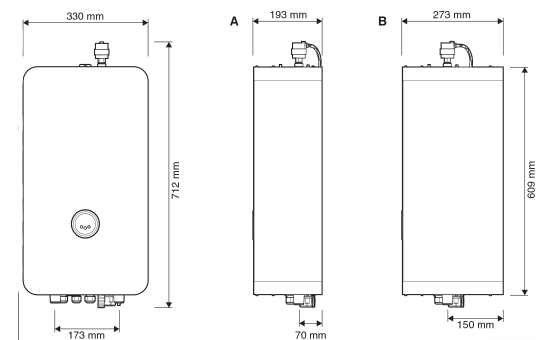
| Height in mm | 712 |
| Width in mm | 330 |
| Depth in mm | 273 |
| Safety valve connection | 1/2" |
| Heating connection dimensions, flow/return | G3/4" - external cylindrical thread per ISO 228-1 G |
| Energy efficiency class for heating | Class D |
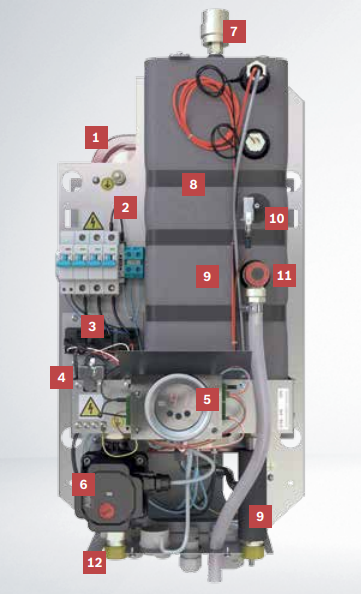
Inside view
Frequently asked questions
- How do I choose the correct output for a BOSCH electric boiler? Just as with gas boilers, start from the calculated heat loss of the building being heated. With electric boilers it is additionally essential to verify that your electrical connection's capacity allows it - higher outputs (from roughly 12 kW upwards) usually require a three-phase 400 V connection and a correspondingly sized main circuit breaker, which a revision technician or the electricity distributor can confirm for you.
- Is an electric boiler worth it compared to a gas boiler or a solid-fuel boiler? An electric boiler has the lowest purchase price and the simplest installation (no flue gas extraction is needed since nothing is burned), but running costs for electricity are usually higher than for gas or wood/coal for the same amount of heat delivered. It is particularly suitable where gas is not available, as a supplementary/backup source, or for a building with low consumption (well-insulated new builds, cottages, flats).
- How does the electric boiler regulate its output? Most models switch the individual heating elements on/off gradually (in stages); some more modern models also allow smoother output modulation - this affects the smoothness of the heating and, to some extent, the service life of the switching components.
- Can I install this electric boiler myself? Connection to the electrical network, inspection and commissioning must be carried out by a person with electrical qualifications in accordance with the applicable standard STN 33 2000 and related regulations - self-installation is not permitted, either for warranty or safety reasons.
- Can this electric boiler also heat domestic hot water? With many models, yes, usually in combination with a separate hot water tank and a switching (3-way) valve, which switches between the heating circuit and heating the tank - the exact option and required accessories for this particular model can be found in the technical parameters above, or consult our customer service.
This particular BOSCH model has an output of 9 kW - as a rough guide this corresponds to a noticeably higher electric current (with a three-phase connection) than you would expect from an ordinary household appliance, so it is necessary to check the capacity of the house's circuit breaker and connection beforehand.
Additional parameters
| Category: | BOSCH Junkers Tronic |
|---|---|
| Warranty: | 2 years |
| Weight: | 22.2 kg |
| EAN: | 4057749630797 |
| EAN: | 4057749630797 |
| Dimensions: | 712 x 330 x 273 |


Product rating
Be the first who will post an article to this item!
Discussion
List of discussions
 Vladimír
ATRIA.SK
 Renáta Lehotská
 Radka ATRIA.SK
 Veronika
Atria.sk
 Miroslav
Radka ATRIA.SK
 adrian
stano
Michal
Michal
Atria.sk
Michal
Atria.sk
Michal
Atria.sk
Michal
About the company
For more than 125 years, we have been supplying the market with efficient, easy-to-operate and at the same time reliable equipment that creates warm and cozy homes for people. Bosch Thermotechnology today offers its customers worldwide solutions for room climate, hot water and decentralized energy management.
Since 1932, the brands Junkers and Bosch have been united by a strong partnership. The merger enabled the combination of traditional craftsmanship with the most modern technology. Under the Bosch brand, we now focus on the future with intelligent building technology, in which thermal technology plays an important role.
The traditional brand Junkers continues, because history, tradition and experience are still embedded in every Bosch-branded product. Junkers means more than 120 years of proven technology and the highest quality for us; we proudly created a memorial for this brand with its own museum. At the company in Wernau, we present the continuation of the history and the life's work of the founder Hugo Junkers.
History
In 1886, Robert Bosch founded the "Workshop for Precision Mechanics and Electrical Engineering" in Stuttgart. This was the beginning of today's globally active company. From the very beginning, innovation and social responsibility were characteristic of the company.
1886 - 1905 - The history of the Bosch company begins with many first steps. Steps toward independence, into the automotive market, into markets outside Germany and into the main production hall.
1906 - 1925 - The company's first astronomical global upswing was brutally interrupted by World War I, after which the Bosch company had to transform and focus on innovation to cope with its consequences.
1926 - 1945 - The Bosch company coped with the speed of the economic crisis and the dictates of National Socialism through the power of innovation and perseverance, until World War II brought enormous challenges once again.
1946 - 1959 - At the end of World War II, the Bosch company lost its international branches for the second time. A large part of its production facilities lay in ruins. The following two decades were devoted to reconstruction, but also to entering new business areas.
1960 - 1989 - The period between the 1960s and 1980s was marked in the Bosch company by a transformation that turned it into a diversified group of independently managed divisions, a global company and a market leader in the field of automotive electronics.
1990 - 2016 - The Iron Curtain fell, new markets emerged in Asia and software opened up new opportunities for Bosch. The last three decades brought rapid economic change, which the company had to face head-on.


We are Bosch
Our mission explains what drives us, what we have in common and what we stand for. We want to leave a lasting mark in the world — a mark achieved by a unique, exceptional team.
Our values — what we build on
Our values reflect the way we do business: Our professional ethics in our dealings with our business partners, investors, employees and society.
Future and results orientation
We focus on results. This enables us to secure our future and at the same time
creates a solid foundation for socially beneficial projects of our company and the Robert Bosch Foundation.
Responsibility and sustainability
We act economically and responsibly in the interest of the entire society and the environment.
Initiative and consistency
We act proactively, take entrepreneurial responsibility and are consistent in pursuing our goals.
Openness and trust
We communicate important topics of our company in a timely and open manner. This represents the best foundation for a relationship based on trust.
Fairness
In our mutual contact and with business partners, we consider mutual fairness to be a condition of our success.
Reliability, trustworthiness, legality
We promise only what we can fulfill. We accept agreements as binding and respect and comply with the law in all our business transactions.
Diversity
We value diversity and promote it, because it enriches us and is a source of our successes.
Bosch in Slovakia
Bosch already had its first representation in former Czechoslovakia as early as 1920. It resumed business activities in Prague in the autumn of 1992 and opened its first branch in Bratislava the following year.
The company in Slovakia operates in three locations and employed more than 1,000 employees in 2020 (as of December 31, 2020). The consolidated turnover in 2020 reached 440 million euros.
The regional company represents the commercial, marketing and service activities of the company
Bosch products and services are designed to fascinate and improve the quality of life by providing innovative and useful solutions. Thanks to this, Bosch worldwide offers technologies that are "Created for life."
