
Hot water cylinder: a complete guide to choosing one for a family house in 2026
The hot water cylinder is one of the appliances we think about least at home – until it stops working or a high energy bill takes us by surprise. Yet a well-chosen cylinder can have a major effect not only on everyday comfort but also on the annual cost of heating water, which accounts for 15 to 25 % of total energy consumption in the average Slovak family house. In 2026, with natural gas and electricity prices still at historic highs, this choice deserves far more careful thought than it used to get.
This article gives you a complete overview: from the basic types of cylinder, through calculating the right volume, to specific recommendations for different situations – a small flat, a larger family, or a combined system with a heat pump or solar. You will also find specific products that we actually sell, with their specifications and what they are suited to.
Why choosing a cylinder matters more than you think
Many homeowners approach a hot water cylinder the same way as a washing machine – they buy something mid-priced and hope it will work. The trouble is that a cylinder is not a stand-alone appliance. It is part of the home's heating system, and whether it is sized correctly (or incorrectly) affects:
- Energy consumption – an undersized cylinder forces the boiler or heat pump into an excessive number of short starts (known as cycling), which dramatically reduces efficiency
- Comfort – a cylinder that is too small means a cold shower in the middle of the family's morning routine, while one that is too large means needless heat losses
- System service life – an unsuitable cylinder shortens the life of the boiler or heat pump
- Hygiene and safety – under the applicable legislation (STN EN 806), the hot water in the cylinder must be heated to at least 60 °C to eliminate Legionella bacteria
So a cylinder is not just a "tank of hot water". It is a key element of the whole system and needs to be chosen with care.
Basic types of hot water cylinder
Before we get into volume calculations, it is important to understand what types of cylinder exist and which one suits your case.
1. Indirect cylinder (cylinder with a heat exchanger coil)
This is the most common type in family houses connected to a boiler (gas, condensing) or a heat pump. The water in the cylinder is heated via a heat exchanger through which the primary circuit (boiler) flows. The drinking water never comes into direct contact with the heat source, which is ideal in terms of hygiene.
Advantages: high heating output, reliability, can be combined with several heat sources (boiler + solar, boiler + heat pump). Disadvantages: larger dimensions, higher purchase price than electric water heaters.
2. Direct electric water heater
An electric heating element heats the water directly in the tank. Suitable for smaller flats, cottages, holiday properties or as a backup source. In 2026, running purely on electricity (without photovoltaics or a night-time tariff) is fairly expensive – at an average electricity price of 0.18–0.22 €/kWh, heating a 200-litre cylinder will cost you 1.50 to 2.50 € a day.
3. Combined (twin-coil) cylinder
It has two heat exchangers – one for the primary source (boiler) and a second for a renewable source (solar collectors, heat pump). Ideal for houses with a solar system, or with a heat pump as the primary source and a gas boiler as backup.
4. Single-coil cylinder for solar systems
A special variant for houses with a solar system, where the lower heat exchanger is designed for the low temperatures of the solar collector and the upper one for top-up heating by a conventional source.
5. Instantaneous water heater (no cylinder)
Technically speaking it is not a cylinder but an alternative to one. It heats water continuously without storing it. Suitable for households with low and irregular consumption, but its output is limited when demand is higher.
Overview of the basic types of hot water cylinder and their typical uses
How to calculate the right cylinder volume
This is the number one question homeowners ask when choosing. Unfortunately, "it depends" is the right answer here – the cylinder volume depends on several factors at once. Let us go through them step by step.
Step 1: Find out how many people are in the household and what their habits are
This is the basic parameter. Each person uses on average 40–60 litres of hot water a day (an 8–12 minute shower, washing up, personal hygiene). If the family has a bath, allow 150–200 litres per fill. A chef who cooks every day and uses large amounts of hot water has different needs from someone who spends most of the day at work.
Indicative daily hot water consumption by type of person:
- Adult, shower – 40 to 55 litres
- Adult, bath – 100 to 150 litres
- Child, shower – 20 to 35 litres
- Child, bath – 60 to 80 litres
Step 2: Identify peak demand
The cylinder must cover peak demand – typically the hour in the morning when every member of the family showers before work and school. For a family of 4 this can be 120 to 180 litres within 30–45 minutes. The cylinder must be able to deliver this amount of hot water without cooling down significantly.
Step 3: Take the heat source and its output into account
The output of the heat source directly affects how quickly the cylinder heats up. A fast, powerful boiler can work with a smaller cylinder because it reheats it quickly. A heat pump has a lower output and heats the cylinder more slowly – here a larger volume is needed as a "reserve".
- Gas condensing boiler 20–24 kW → cylinder 150–300 litres
- Air-to-water heat pump 6–10 kW → cylinder 200–400 litres
- Ground-source heat pump 8–12 kW → cylinder 300–500 litres
- Solar system (4–8 collectors) → cylinder 200–400 litres
Step 4: Summary of recommendations by household size
Recommended cylinder volume by number of people in the household
Vaillant uniSTOR cylinders – a premium choice for family houses
Vaillant is one of the best-selling and most reliable cylinder brands on the Slovak market. The uniSTOR VIH R series comprises indirect stainless steel cylinders designed to work with Vaillant condensing boilers, yet fully compatible with other boilers and heat pumps too. They feature excellent thermal insulation (polyurethane foam), high-quality enamel protection of the tank and a long warranty.
Vaillant uniSTOR VIH R 300 – for a family of 4 to 6

Vaillant uniSTOR VIH R 300 – 300-litre indirect cylinder
The Vaillant uniSTOR VIH R 300 is ideal for families of 4 to 6. With a volume of 300 litres it covers the morning peak without difficulty, even in households where several people shower at the same time or where the bath is used regularly. The cylinder has a heat exchanger with a surface area of 2.0 m², which guarantees rapid heating with a sufficiently powerful heat source.
- Volume: 300 litres
- Max. cylinder temperature: 90 °C
- Heat exchanger surface area: 2.0 m²
- Floor-standing, vertical position
- Enamelled steel tank with magnesium anode
- Energy efficiency class: C
This cylinder is also suitable for combination with a solar system, where a solar heat exchanger can be connected via the lower inlet. For households with an air-to-water heat pump (output 6–9 kW), 300 litres is the optimum choice – the cylinder acts as a buffer that evens out the difference between the heat pump's slow heating and peak demand.
Vaillant uniSTOR VIH R 400 – for larger families and more demanding systems

Vaillant uniSTOR VIH R 400 – 400-litre cylinder for demanding households
When a 300-litre cylinder is not enough, the Vaillant uniSTOR VIH R 400 comes into play. This model is intended for households with higher hot water consumption – families of 6 or more, houses with a sauna or a larger whirlpool bath, or systems where the hot water is also fed to underfloor heating (in combination with a buffer tank).
- Volume: 400 litres
- Max. cylinder temperature: 90 °C
- Heat exchanger surface area: 2.6 m²
- Floor-standing, vertical position
- Lower heat losses thanks to thicker insulation
In practice the VIH R 400 is very often installed together with an air-to-water heat pump with an output of 9–14 kW. In these systems a larger cylinder is an investment in both comfort and economy – the heat pump can run longer cycles (working more efficiently) and the cylinder serves as a thermal battery.
Vaillant uniSTOR VIH R 500 – for large houses and commercial use

Vaillant uniSTOR VIH R 500 – 500-litre cylinder for large houses
The Vaillant uniSTOR VIH R 500 is the flagship model of the series. With a volume of 500 litres it is suitable for:
- Large family houses with 8 or more people
- Guest houses and small accommodation facilities
- Houses with a swimming pool (where the hot water is also used to top up the pool heating)
- Systems with several heat sources (boiler + solar + heat pump)
- Businesses and premises with a morning peak in demand
It is important to know that a 500-litre cylinder requires a sufficiently powerful heat source – with a 24 kW gas boiler, heating the whole cylinder from 15 °C to 60 °C takes about 3 hours. With a 10 kW heat pump it can take as long as 5–6 hours. For volumes like these, night-time heating (cheaper electricity tariff) or a combination of several heat sources is therefore recommended.
Protherm cylinders – reliability at a sensible price
The Protherm brand is well established in Slovakia and likewise belongs to the Vaillant Group – so the two share the same group technology and quality, while Protherm offers more affordable solutions for customers for whom the brand name is not a priority.
Protherm FE 120 BM – compact floor-standing cylinder
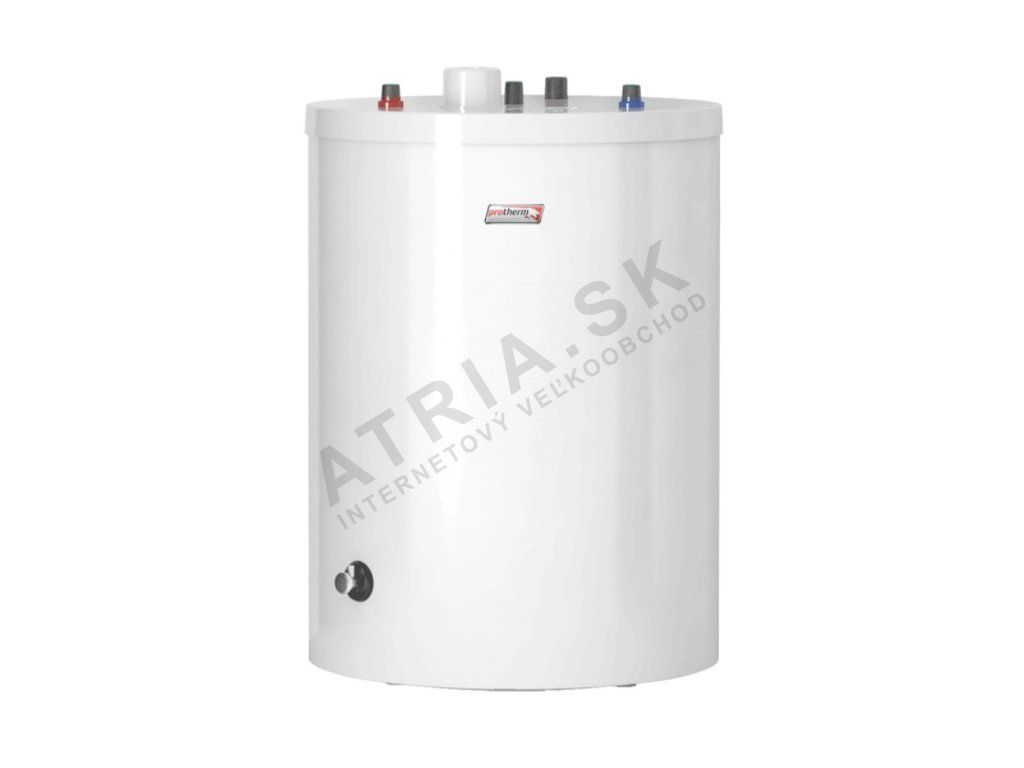
Protherm FE 120 BM – 120-litre floor-standing cylinder, suitable for 2-3 people
The Protherm FE 120 BM is a floor-standing cylinder with a volume of 120 litres, ideal for:
- A household of 2 to 3 with normal consumption
- Holiday homes and cottages
- Smaller flats with a condensing boiler
- Situations where installation space is limited
The cylinder is fitted with a single heat exchanger for indirect heating, an enamelled tank and a magnesium anode for corrosion protection. Thanks to its compact dimensions and floor-standing design, installation is simple and takes up little space. We would not recommend this model for households with a heat pump or solar – 120 litres is generally too small for those systems.
Protherm FE 200 BM – an all-round cylinder for the typical family house
The Protherm FE 200 BM, with a volume of 200 litres, is the most popular cylinder in the medium-sized household category. It covers the needs of 3 to 5 people with normal showering habits. Its excellent value for money makes it a bestseller among installers looking for a reliable solution without unnecessary expense.
- Volume: 200 litres
- Enamelled steel tank
- Heat exchanger for indirect heating
- Magnesium anode included
- Floor-standing design, vertical position
- Compatible with most gas boilers on the market
Vaillant VIH Q 75 B cylinder – a solution for small spaces
A category of its own is the Vaillant uniSTOR VIH Q 75 B cylinder with a volume of 75 litres. This model is intended primarily for:
- Small flats and studio flats (1–2 people)
- Offices and premises with limited DHW demand
- A backup cylinder for more remote parts of the house (garage, workshop)
- Renovations where there is no room for a larger cylinder
The VIH Q 75 B is compact, can be installed horizontally or vertically, and is designed primarily for indirect heating by an external source (boiler). It is not enough for larger households, however – with 4 people, a cylinder like this would be empty after the first two showers.
Cylinder material: enamel, stainless steel or plastic?
The material of the cylinder tank has a significant effect on the service life and safety of the whole system.
Enamelled (vitreous-enamelled) steel
The most widely used material in the mid-range and upper category. The enamel layer protects the steel against corrosion, is hygienically safe and is approved for drinking water. Disadvantage: if the enamel is damaged (e.g. by thermal shock), corrosion can progress. That is why every enamelled cylinder includes a sacrificial magnesium anode, which needs to be checked regularly (every 2–4 years) and replaced if necessary.
Stainless steel (INOX)
A premium material that needs neither an anode nor enamelling. Resistant to corrosion, with a long service life (25 years or more). The higher purchase price is offset by lower maintenance requirements. Recommended where the water is hard (above 20 °dH) or aggressive, with a higher chloride content.
Plastic cylinders
Mostly used in the cheaper category or for industrial applications. They are less common for drinking water in family houses – poorer heat storage, limited temperature (max. 70 °C), shorter service life.
Cylinder heat losses: what they really cost you every day
A cylinder's heat loss is the energy it loses to its surroundings over 24 hours at a standard water temperature of 60 °C and a room temperature of 20 °C. This value is given in kWh/day and directly affects your costs – even if you draw no water at all, the cylinder loses heat every day that the heat source has to make up.
Daily cylinder heat losses by volume – larger volume = higher standing losses
As you can see, a larger cylinder has higher standing heat losses. At an electricity price of 0.20 €/kWh this sounds negligible – the difference between a 200-litre (0.95 kWh/day) and a 400-litre cylinder (1.65 kWh/day) is 0.14 € a day, which is about 50 € a year. But if the cylinder stands in an unheated room or a boiler room at 10 °C, the heat losses will be considerably higher. We therefore recommend placing the cylinder in a room with background heating or choosing a model with better thermal insulation.
Cylinders and heat pumps: special requirements
In 2026 heat pumps are enjoying a real boom in Slovakia – subsidy programmes (Zelená domácnostiam III, OPKZP) and high gas prices are moving hundreds of households a year towards this technology. A hot water cylinder used with a heat pump has several special requirements:
- Larger volume – a heat pump heats slowly (output 6–14 kW compared with 20–28 kW for a boiler). The cylinder must have enough capacity to cover peak demand without the heat pump switching on every 10 minutes.
- Larger heat exchanger – a heat pump works with lower primary circuit temperatures (45–55 °C compared with 70–80 °C for a boiler). The heat exchanger must have a larger surface area for adequate heat transfer.
- Low-temperature compatibility – the cylinder must be designed for a heat exchanger inlet temperature of 40–55 °C (some old models are optimised for 70 °C and work inefficiently with a heat pump).
- Legionella hygiene – at the lower temperatures of a heat pump (below 55 °C) there is a risk of Legionella bacteria multiplying. The solution is regular (weekly) thermal disinfection, heating the cylinder to 60–65 °C, either with an electric immersion heater in the cylinder or with a second heat source.
For combination with a heat pump we recommend at least a 200-litre cylinder per 1 kW of heat pump output – which for a typical 8 kW heat pump means at least 300 litres, ideally 400 litres.
Cylinders and solar systems: how to make the most of the sun
A solar thermal system (not photovoltaics, but thermal collectors) can heat a cylinder to 60 °C on a sunny day without any energy from the boiler. In Slovak conditions that means around 180–220 sunny days a year, when solar covers 60–70 % of the annual hot water demand.
For a solar system the best option is a twin-coil cylinder with two heat exchangers:
- Lower heat exchanger (larger, for lower temperatures) – connected to the solar circuit
- Upper heat exchanger (smaller, for higher temperatures) – connected to the boiler for top-up heating
Cylinder volume for a solar system: the basic rule is 50–80 litres per m² of collector. For a typical domestic solar system with 4–6 m² of collectors (for a family of 4) you therefore need a cylinder of 200–400 litres.
Installing a cylinder: what you need to know beforehand
A hot water cylinder is not an appliance you fit yourself from a YouTube tutorial. Installation requires a qualified installer, because it involves:
- A pressure vessel connected to the water supply (mandatory pressure test)
- Connection to a boiler or heat pump (professional installation, inspection)
- Electrical connection (socket, fuse and, for electric heating, a circuit breaker)
- Installation of a safety valve and expansion vessel (mandatory under STN EN 1487)
Before installation, consider these practical questions:
- Space – a 300-litre cylinder is 165–175 cm high and 60–65 cm in diameter. Will it fit through the boiler room door? Can the floor bear the load?
- Location – the cylinder should be as close as possible to the points of use (bathroom, kitchen). Every metre of pipe = heat losses and waiting for hot water.
- Circulation – if the cylinder is more than 6 metres from the bathroom, we recommend installing a circulation pump, which keeps the hot water in the pipe always "ready".
- Water hardness – with hard water (above 15 °dH), consider a water softener or choose a stainless steel tank instead of an enamelled one.
Cylinder prices in 2026: how much will you really pay?
Cylinder prices on the Slovak market in 2026 depend on the brand, volume, material and type of heat exchanger. Indicative prices:
- Cylinder 80–120 litres (economy class): 200–450 €
- Cylinder 80–120 litres (mid-range, enamelled): 350–600 €
- Cylinder 200 litres (mid-range): 450–750 €
- Cylinder 300 litres (premium class, Vaillant/Protherm): 750–1 100 €
- Cylinder 400–500 litres (premium class): 1 000–1 600 €
- Twin-coil cylinder 300 litres (solar): 900–1 400 €
Installation costs have to be added to the price of the cylinder – for a straightforward replacement of an old cylinder with a new one, installers charge from 150 to 350 € including materials (seals, safety valve, expansion vessel). In a new build or a complete renovation of the heating system the cylinder is part of a larger job, and the labour price is naturally different.
Important: if you buy the cylinder as part of a new heat pump or boiler, its purchase can be claimed under the subsidy schemes (Zelená domácnostiam, or a contribution from SPP). Before buying, we recommend checking the current call with the Slovak Innovation and Energy Agency (SIEA).
Cylinder maintenance: how to extend its service life
With proper maintenance a hot water cylinder lasts 15–25 years. Without maintenance it may be finished after just 8–10 years (corrosion, sediment, a damaged anode). Here are the basic maintenance steps:
- Check the magnesium anode every 2 years – the anode is sacrificed instead of the steel tank. If it has worn down to less than 50 % of its original weight, it must be replaced (price of a replacement anode: 20–60 €).
- Run thermal disinfection once a year – heating the cylinder to 70 °C for 1 hour. This eliminates Legionella bacteria and slows the build-up of limescale.
- Flush the cylinder once every 2–3 years – use the drain valve to drain the sludge deposits from the bottom of the tank. Deposits reduce capacity and impair the heat exchanger.
- Check the safety valve once a year – the valve must not be corroded or blocked. Test it by lifting the lever by hand.
- Check the thermal insulation – damaged insulation increases heat losses. When refurbishing the cylinder, give it additional insulation.
Cylinder or instantaneous water heater? A fundamental decision
We still keep hearing the question: "Do I need a cylinder at all? Wouldn't an instantaneous water heater do?" The answer depends on the situation:
An instantaneous water heater is the better choice if:
- You live alone or as a couple and shower only occasionally
- It is for a second bathroom in the house (garage, garden house)
- You have no room for a cylinder
- You need immediate installation without an installer (electric instantaneous heater)
A cylinder is the better choice if:
- There are 3 or more people in your household
- You use a bath
- You have a boiler or heat pump (a cylinder increases their efficiency)
- You want to use solar collectors
- You care about lower water heating costs in the long term
Frequently asked questions (FAQ)
How big a cylinder do I need for a family of 4?
For a family of 4 with normal showering habits (2 adults, 2 children) we recommend a cylinder with a volume of 200 to 300 litres. If the family uses a bath, has showers with a higher flow rate or everyone showers within a short time in the morning, go for 300 litres. With a heat pump as the heat source we choose the upper end – 300 litres is the minimum, ideally 400 litres.
What is the service life of a hot water cylinder?
With regular maintenance (anode check, flushing, thermal disinfection), a cylinder with an enamelled tank lasts 15 to 20 years and a stainless steel cylinder 20 to 30 years. Without any maintenance this shortens to 8 to 12 years. Investing in regular maintenance (approx. 50–100 € every 2 years) is clearly worthwhile.
Can I install a cylinder horizontally?
Some cylinders (e.g. the Vaillant uniSTOR VIH Q 75 B) allow horizontal installation. Most cylinders, however, are designed for the vertical position – the thermocline (heat stratification) works far more effectively when the cylinder is upright. Installing larger cylinders horizontally reduces efficiency and increases heat losses. Always check the technical documentation for the specific model.
What is a magnesium anode and why does it need checking?
A magnesium anode is a rod made of magnesium alloy located inside the cylinder. It works on the principle of cathodic protection – it "sacrifices itself" to the corrosion process instead of the steel tank. If the anode is completely used up (worn away), corrosion starts to attack the tank itself and the cylinder may begin to crack or rust. The anode should be checked every 2 years and replaced depending on its condition. Stainless steel cylinders do not need an anode.
Is an expansion vessel needed with a cylinder?
Yes, by law (STN EN 1487) an expansion vessel is a mandatory part of a pressurised system. Water expands as it is heated – without an expansion vessel the pressure in the system would rise to a dangerous level and the safety valve would have to discharge water constantly. The expansion vessel (volume 8–25 litres depending on the cylinder) absorbs this pressure surge. Its volume is specified by the designer or installer on the basis of the cylinder volume and the mains water pressure.
How long does it take to heat a cylinder to operating temperature?
It depends on the output of the heat source and the volume of the cylinder. As a guide: a 24 kW gas condensing boiler heats a 300-litre cylinder from 15 °C to 60 °C in approx. 45–70 minutes. A 9 kW air-to-water heat pump heats the same cylinder in 2.5 to 4 hours. A 2 kW electric heating element in the cylinder heats 200 litres in 4–6 hours. With a heat pump we therefore recommend scheduling cylinder heating for the night hours (cheaper electricity tariff or making use of the heat pump's night-time operation).
Conclusion: so how do you choose the right cylinder?
Choosing a hot water cylinder is not rocket science, but it does call for a little systems thinking. So let us sum up the key points:
- For 1–2 people a cylinder of 75–120 litres is sufficient (Vaillant VIH Q 75 B, Protherm FE 120 BM)
- For 3–4 people with a boiler a cylinder of 200–300 litres is ideal (Protherm FE 200 BM, Vaillant uniSTOR VIH R 300)
- For 4–6 people or a heat pump we choose 300–400 litres (VIH R 300, VIH R 400)
- For large houses, guest houses or several heat sources a 500-litre cylinder is the best option (Vaillant uniSTOR VIH R 500)
If you are not sure which cylinder is right for your house, we recommend consulting a specialist – correct sizing pays off not only in terms of comfort but also in terms of long-term energy costs. The cylinder you choose today will be with you for 15 to 25 years. It is worth giving it a little attention.
Do you have a question on this topic?
Can't decide, or dealing with a specific situation in your home? Write to us - we will be happy to advise.