
Introduction: why the controller is the heart of your heating system and why we focus on Hunter and Toro technology and solar solutions
In 2026 the heating equipment market is at a major turning point. Energy prices, although they have stabilised after the crisis years, remain at levels that demand maximum efficiency from every watt delivered to your home. At the same time, stricter legislation on the energy performance of buildings and the mandatory installation of renewable energy sources (RES) is forcing property owners to look for intelligent solutions that not only save energy but also maximise the yield of their systems.
However, when people ask about irrigation controllers, there is often a misunderstanding or a specific context involved. On the Slovak market, particularly in connection with brands such as Hunter and Toro, which dominate the irrigation sector, the term "controller" can refer to two completely different areas: on the one hand there are classic automated irrigation systems for gardens and fields, and on the other, which is the more common reason for searches on Slovak sites such as ATRIA, there is the control of solar thermal systems, which uses similar principles for controlling pumps, flow meters and thermostatic valves; these are technically close to the logic of irrigation systems but serve to heat water or run underfloor heating.
This article is a comprehensive guide that brings these two worlds together. We look at how advanced controllers work and why brands such as Hunter and Toro are the standard in irrigation, but we also take a detailed look at their application in solar systems, which today form the core of efficient heating. You will find out how the control logic works, why choosing the right controller matters, how analogue and digital systems differ and what role is played by solar pump units such as the Euroster 813 Solar or the Solar pump unit ZP2-12 ECO.
The aim is not just to sell a product but to give you real technical depth, so that you understand why your investment in a quality controller will pay for itself several times over in lower energy bills and a longer service life for the whole system. From the legislative changes of 2026 to practical tips on installation and maintenance – this is a complete guide to the world of intelligent control of heat and irrigation flows.
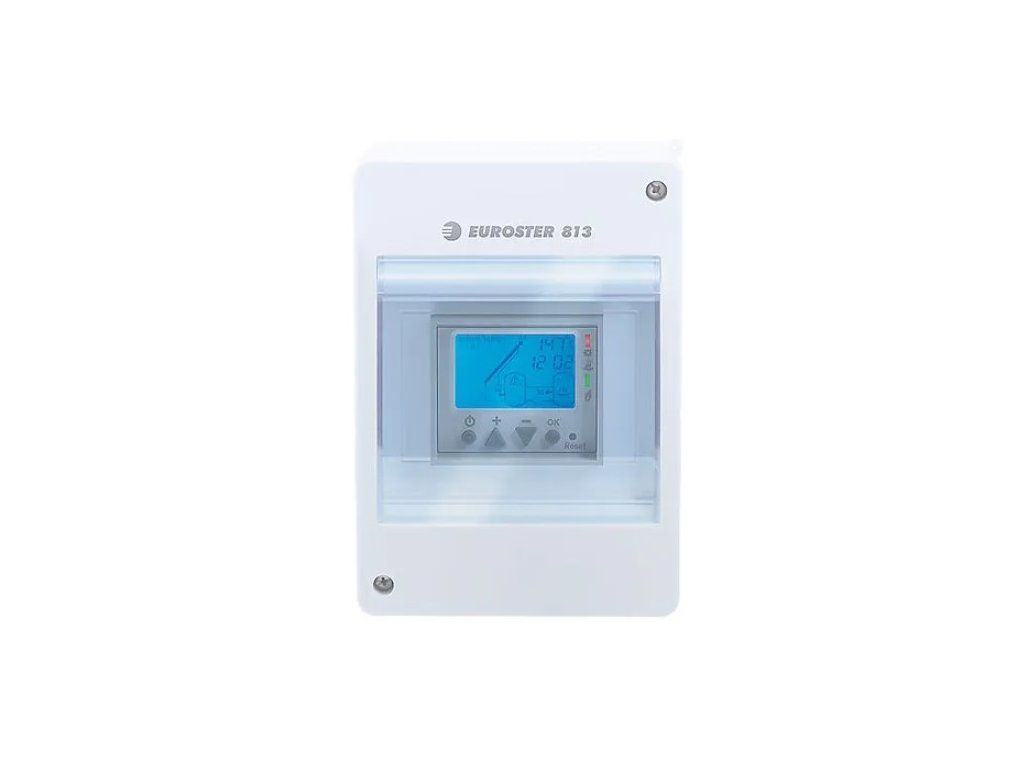
The Euroster 813 Solar room thermostat is one of the key components of modern solar systems, providing precise temperature control and pump operation.
The difference between irrigation and heating automation: where the logic of Hunter and Toro meets
At first glance, irrigation controllers and heating controllers may seem to be two completely different disciplines. However, when we look at how they work, we find that both systems rely on the same physical laws and control logic. The difference lies primarily in what is being controlled and which parameters are monitored.
Irrigation systems (Hunter, Toro) are designed to operate electric valves (solenoid valves), which open and close according to a time schedule. Their main task is to distribute water to lawns, flower beds or agricultural land. Here the controller acts as the "brain" that starts the individual stations (zones) at a precise time and for a precise duration. The important inputs are soil moisture (available in advanced systems), the weather and the programmed schedule.
Heating and solar systems use similar logic, but instead of opening irrigation valves they control circulation pumps and mixing valves. Here the aim is to maintain the optimum temperature difference between the solar collector and the hot water cylinder. If the temperature at the collector is higher than in the cylinder by a defined value (e.g. 5 °C), the controller switches the pump on. If the temperature drops, it switches the pump off. This logic is identical to the way Hunter or Toro start irrigation on the basis of a moisture sensor, except that here the "sensor" is the temperature difference.
So why do people search for "hunter controllers" in the context of heating? The answer is that many companies installing solar systems use components and logic designed for controlling pipework systems, which are technically very similar to irrigation systems. What is more, brands such as Hunter and Toro are synonymous with quality in water control. Since the distinction is not always clear in Slovak, users often look for information about these brands in connection with pump control in solar systems as well.
Today we already have integrated solutions that combine the two. There are systems that can control not only garden irrigation but also a solar system for heating pool water or the central heating. That is the future we see in 2026. Modern controllers can communicate via the IoT (Internet of Things), track both water and heat consumption and optimise operation according to the current electricity price or the weather.
A key element here is the flow meter. In irrigation systems it measures the amount of water in order to prevent overwatering or underwatering. In solar systems the flow meter is critical for detecting faults (e.g. if the heat transfer fluid stopped circulating). That is why our range includes products such as the Electronic flow meter for GH 26, which is an essential component for precise flow control in both types of system.
Hunter and Toro: global leaders in automation and what they mean for local solutions
When you hear Hunter or Toro, most people picture professional irrigation systems for golf courses, parks or large commercial sites. Yet in the world of water flow automation these two brands are the undisputed leaders. Their technology is characterised by extreme reliability, weather resistance and advanced intelligence.
Hunter Industries was founded in 1963 and today is a global leader in the design and manufacture of irrigation products. Its controllers are known for their modular design. The system makes it easy to add further zones, integrate rain sensors and even manage everything remotely through mobile apps. For homeowners in 2026 it is important to know that modern Hunter systems are no longer just about setting a time. They are complex ecosystems that respond to the real needs of plants.
The Toro Company, best known for its lawnmowers, also has top-class irrigation and water control solutions in its portfolio. Its approach to automation is often more focused on integration with existing infrastructure and on ease of use for the ordinary user. Toro technology is characterised by highly accurate dosing and robust electronics.
How do these brands come into the picture with heating and solar systems? The answer is technological convergence. The principles that Hunter and Toro developed for controlling solenoid valves are also used in solar systems to control three-way valves and circulation pumps. In addition, many installation companies in the Slovak Republic use components and software from these manufacturers for the control of heating systems too, because their logic has been proven over decades.
Another important factor is energy efficiency. Modern Hunter and Toro controllers are designed to minimise electricity consumption. At a time when energy prices are a sensitive issue, this feature is crucial. The systems use low-voltage control and intelligent sleep modes that save energy without sacrificing functionality.
In the context of the Slovak market it is important to stress that, although direct imports of Hunter and Toro systems can be more expensive, there are alternative solutions that use similar logic and are more affordable while offering the same level of performance. That is exactly why the ATRIA e-shop range includes products such as the Controller GH 26, which is intended for solar systems and uses proven control principles compatible with the highest standards on the market.
A practical example is the installation of a solar system on a family house. Someone who wants a fully automatic system that takes care of water heating in the summer months and helps out in winter needs a controller that responds to temperature changes immediately and accurately. This is where irrigation logic (responding to a sensor) meets heating logic (responding to temperature).
Solar pump units: the heart of modern heating in 2026
In 2026 solar energy is one of the most efficient ways of obtaining heat for households. The key to its success is not only the solar collector itself but above all the solar pump unit. Without a quality controller, a solar system would be merely a passive collection system with no control over when and how heat is transferred to the cylinder.
A solar pump unit is a device containing all the components needed to control the circulation of the heat transfer fluid (a mixture of water and an anti-corrosion solution) between the solar collector and the cylinder. It includes:
- Circulation pump: Usually a high-efficiency, low-consumption pump that can overcome the resistance in the pipework.
- Temperature sensors: One on the collector and one in the lower part of the cylinder. Some systems also have a third sensor for the upper part of the cylinder.
- Control module: The brain of the system, which compares the temperatures and decides whether to switch the pump on or off.
- Flow meter (optional): For monitoring the flow rate and detecting faults.
The best example of such a unit in our range is the Solar pump unit ZP2-12 ECO. This device is designed to be as easy as possible to install while offering maximum flexibility. It is ideal for small to medium-sized solar systems where solar energy needs to be used efficiently to heat domestic hot water.

The Solar pump unit ZP2-12 ECO is a compact and efficient solution for controlling circulation in solar systems.
Another key product is the Solar pump control unit ZPS 18e - 01 ECO. This model is suitable for higher-output systems or for systems that require more precise control and greater reliability. The difference between these models lies in the maximum current they can switch and in the range of functions they offer.
What makes these units special? Their capacity for adaptive control. Modern units do not switch the pump on solely on the basis of a fixed temperature difference. Some more advanced models can also take into account the outdoor temperature, historical data on system performance and even weather forecasts. This means that if an overcast spell is forecast, the system can start circulating earlier to maximise heat capture, or conversely, if strong wind and cold are expected, the system can adapt to prevent overheating.
In the context of energy prices in 2026 it is important to stress that solar pump units are designed to have minimal power consumption of their own. The circulation pumps in these units are often of the EC (electronically commutated) type, which can regulate their speed as required. This means the pump does not need full output when the pressure in the system is low, which leads to further electricity savings.
One of the questions customers ask most often is whether these units can also be used for underfloor heating. The answer is yes, but with certain limitations. Solar pump units are primarily intended for heating water in cylinders. For underfloor heating these systems need to be integrated with mixing circuits and control valves, which requires a more complex configuration. That is exactly why the range also includes specialised solutions such as the Solar pump unit ALEX HX10 for the MiniSOL controller, which is designed for specific applications and integrated solutions.
Euroster 813 Solar technology and other innovative solutions for the home
One of the most popular products in the solar controller category on the Slovak market is the Euroster 813 Solar. This product has earned a reputation as a reliable partner for thousands of Slovak households. Why is that? The answer is its simplicity, robustness and ability to work in a wide range of conditions.
The Euroster 813 Solar is a room thermostat with an integrated controller for solar systems. Its main advantage is that it combines room temperature control with control of the solar system. This means you can have a single device that not only maintains the required temperature in the house but also optimises the use of solar energy for heating water.
Key features of the Euroster 813 Solar:
- Integrated logic: It does not require separate controllers for the solar system, which reduces the number of components and the risk of faults.
- Flexibility: It allows various types of sensors and control elements to be connected.
- Cost-effectiveness: It optimises pump operation to achieve maximum efficiency with minimum electricity consumption.
- Safety: It includes protective functions against overheating and freezing.
In 2026 it is important for devices like this to be compatible with modern smart home systems. The Euroster 813 Solar offers the option of integration with external systems, which allows homeowners to monitor the status of the solar system and control it remotely from a mobile phone.

The Solar pump control unit ZPS 18e - 01 ECO is intended for more demanding applications and offers advanced functions for precise control.
Another interesting product is the Controller GH 26. This device is often used in industrial and commercial applications, but it also has its place in modern family houses where high accuracy and reliability are needed. The Controller GH 26 is known for its ability to control several circuits at once, which makes it ideal for systems that combine solar heating with traditional heat sources.
For those looking for specialised solutions for particular systems, there is the Solar pump unit ALEX HX10 for the MiniSOL controller. This device is designed to be compatible with the MiniSOL system and to offer an optimum solution for smaller solar systems. Its advantage lies in its simple installation and low maintenance requirements.
The role of flow meters and sensors in intelligent systems
In every system, whether irrigation or solar heating, a key element is the flow meter. Without accurate flow measurement it is impossible to ensure that the system works properly. The flow meter serves several purposes:
- Fault detection: If the flow drops to zero, the system knows that a fault has occurred (e.g. air in the pipework, a blocked pump) and shuts down to prevent damage.
- Performance optimisation: Measuring the flow makes it possible to regulate the pump speed so as to achieve optimum efficiency.
- Monitoring: It allows the owner to see how much heat is being transferred and how efficiently the system is working.
In our range you will find the Electronic flow meter for GH 26, which is specially designed for use with the Controller GH 26. This flow meter is highly accurate and resistant to impurities in the heat transfer fluid. It is ideal for systems where high reliability and a long service life are required.

The Electronic flow meter for GH 26 is an essential component for precise flow control and fault detection in solar systems.
Besides flow meters, temperature sensors are also important. Solar systems use PT1000 or NTC sensors, which are highly accurate and have a long service life. Correct installation of these sensors is critical to the operation of the system. They must be located at the right points in order to provide accurate temperature readings.
Irrigation systems also use moisture sensors. These sensors measure soil moisture and allow the system to switch irrigation on only when it is really needed. This leads to significant savings in water and energy. Modern systems can combine data from several sensors and create a moisture map of the whole garden.
Legislation and energy standards in 2026: how they affect the choice of controller
The year 2026 brings new challenges in energy and building standards. The European Union and the Slovak Republic have introduced stricter requirements for the energy performance of buildings. One of the key documents is the Energy Performance of Buildings Directive (EPBD), which aims to achieve zero CO2 emissions by 2050.
These changes have a direct impact on the choice of controller. The new standards require systems to be capable of achieving maximum efficiency and minimising energy losses. This means that old, mechanical systems are gradually being replaced by intelligent, digital controllers.
Key aspects of the legislation in 2026:
- Mandatory integration of RES: New buildings must be equipped with renewable energy sources, which includes solar systems for water heating and space heating.
- Energy certificates: Buildings must meet certain energy standards before they can be sold or let.
- Digital monitoring: The ability to monitor energy consumption and CO2 emissions in real time is required.
All this means that choosing a controller is not just a question of price but also of meeting legislative requirements. Modern controllers such as the Euroster 813 Solar or the Solar pump unit ZP2-12 ECO are designed to meet these requirements. They offer options for digital monitoring, integration with external systems and performance optimisation.
Another important aspect is subsidies and grants. In 2026 various support schemes are still available for installing solar systems and energy-saving solutions. To obtain these grants, the installed system must meet certain technical requirements. This means that the choice of controller must comply with the grant conditions.
Real-life examples: how these systems work in practice
Theory is good, but practice is better. Let us look at a few real-life examples of how these systems work in practice and how they can help homeowners save money and energy.
Example 1: Family house in the Bratislava region
The owner of a family house in Bratislava installed a solar system for heating domestic hot water. The system consisted of solar collectors on the roof, a 500-litre cylinder and a Solar pump unit ZP2-12 ECO. Before the installation he used a gas boiler to heat water, which meant high costs every month.
After the solar system was installed, his situation changed dramatically. The system automatically detected when the temperature at the collector was high enough and started the pump. In the summer months the system covered up to 80% of hot water consumption. In the winter months, when there was not enough sun, the system switched automatically to the gas boiler. The total saving over the year was approximately 40%, which amounts to several hundred euros.
Example 2: Combined garden irrigation and solar heating
In one project in Košice, a comprehensive solution was installed that combined garden irrigation and solar heating. It used a Controller GH 26 system with an integrated Electronic flow meter.
The system was programmed to switch irrigation on automatically at night in summer, when the temperature is lower and evaporation is reduced. At the same time it controlled the solar system heating the water in the swimming pool. Thanks to precise control of flow and temperature, both systems achieved maximum efficiency. The owner recorded a 30% saving in water and a 25% saving in energy.
Example 3: Integrated solution for a small business
A small business in Žilina needed a water heating solution for its premises. It installed a system with a Solar pump unit ALEX HX10 for the MiniSOL controller.
The system was designed to be as simple as possible to operate and maintain. Thanks to integrated control and monitoring, it achieved high efficiency and low running costs. The owner was pleased that the system worked without problems and brought him significant savings.
Frequently asked questions and answers (FAQ)
How do you tell an irrigation controller from one for solar heating?
Although both systems use similar logic, they differ in their parameters. Irrigation controllers (such as Hunter, Toro) are focused on operating solenoid valves and measuring water flow. Solar controllers (such as the Euroster 813, ZP2-12) are focused on controlling circulation pumps and measuring the temperature difference. Another key difference is the type of sensors and the control logic.
Can an irrigation controller be used on a solar system?
Technically it is possible, but it is not recommended. Irrigation controllers are not designed to control pumps in solar systems and may lack necessary functions such as temperature difference control or overheating protection. Specialised controllers are the better choice for solar systems.
How often does the flow meter in a solar system need calibrating?
Modern electronic flow meters, such as the one for the GH 26, are usually factory-calibrated and do not need frequent calibration. However, a regular function check is recommended at least once a year, especially if the system is used intensively.
What should I do if the solar system is not working properly?
The first step is to check the controller and the sensors. Check that they are connected correctly and showing the correct values. If the problem is with the flow, check the flow meter and the pump. If the problems persist, contact an installation specialist.
Are solar pump units energy-efficient?
Yes, modern solar pump units are designed to be as economical as possible. They use efficient pumps and intelligent control logic that minimises energy consumption. Compared with traditional systems they can save tens of per cent of the energy.
Can I install a solar system myself?
Installing a solar system requires specialist knowledge and skills. It involves a safety risk and can also lead to damage to the system. We recommend leaving the installation to certified installers who have experience with the type of system concerned.
Conclusion: investing in intelligence pays off
In 2026 the choice of controller for your heating or irrigation system is one of the most important decisions you can make. It will affect not only what you pay for energy but also your everyday comfort and the protection of the environment.
Brands such as Hunter and Toro are strong leaders in irrigation, but their technology and logic have become the foundation for modern solar systems. Products such as the Euroster 813 Solar, the Solar pump unit ZP2-12 ECO and the Solar pump control unit ZPS 18e - 01 ECO represent the best in this field and offer solutions that meet the highest standards.
Investing in a quality controller pays off not only through energy savings but also through a long system life and lower maintenance costs. At a time when energy prices are unstable and legislation is changing, it is important to have a system that is flexible, intelligent and reliable.
Do not forget that correct installation and configuration are just as important as the choice of product itself. If you are in any doubt, do not hesitate to contact our specialists, who will be happy to help you choose the best solution for your needs. Your home deserves the most up-to-date technology, and we are here to provide it.
Do you have a question about this topic?
Can't decide, or dealing with a specific situation in your home? Write to us - we will be happy to advise.