
Thermostat for a gas boiler: how to choose one, what really saves money and what just takes up space on the wall
If you have ever looked at your January gas bill and then glanced at the thermostat on the wall, you have probably asked yourself the same question as thousands of Slovaks every winter: “Would it help if I replaced the thermostat with something better?” The short answer is yes – but only if you know what you are buying and why. The long answer is this whole article.
You will find an overview of models in the room thermostats for gas boilers category – manual, programmable, wireless and WiFi.
In 2026 the price of gas for households is still at a level that turns every kilowatt-hour saved into a real euro. Heating control – in other words, how precisely your boiler responds to the actual demand for heat – is one of the few tools that you as a homeowner have fully in your own hands, with no renovation, no grants and no knocking down walls. All it takes is the right thermostat and the right wiring.
In this article we go through everything: from what a thermostat actually does, through the types of control and compatibility with particular boilers, to real savings in euros and specific products worth considering.
What a gas boiler thermostat actually does – and what it does not
It seems a trivial question, but the answer matters, because many people have distorted expectations. A thermostat does not reduce gas consumption by somehow “metering” the fuel to the boiler. A thermostat is essentially a switch – when the temperature in the room (or in the house) drops below the set value, it sends the boiler a signal to switch on. When the temperature reaches the required level, it switches the boiler off.
The saving comes from two sources:
- Accuracy: A simple bimetallic thermostat can be out by as much as 2–3 °C. That means it heats up to 22–23 °C even though you set 20 °C. Every extra degree represents roughly 6 % higher energy consumption.
- Programming and control: If you know that you leave in the morning and come back in the evening, why heat at full output all day? A programmable thermostat lowers the temperature when you do not need it and warms the house up before you get home.
There are other functions too – weather-compensated control, output modulation, connection of an outdoor temperature sensor – more on those later. But the basics are clear: the thermostat controls when and how hard the boiler works.
Chart: The difference between uncontrolled and controlled temperature over the course of a day. The bimetallic thermostat (red) keeps the temperature considerably higher than necessary.
Types of thermostat – from simple to smart
1. Mechanical (bimetallic) thermostat
The good old dial on the wall. It works on the principle of a bimetallic strip that bends as the temperature changes and mechanically closes or opens a contact. Advantages: cheap (€10–25), simple, needs no batteries. Disadvantages: inaccurate (±2–3 °C), no programming, no way of connecting to the boiler's bus communication. It has no place in a modern home.
2. Digital programmable thermostat
The foundation of modern control. Accuracy of ±0.5 °C and the option of setting a weekly programme (e.g. working days vs. weekend, night vs. day). Prices range from €30 to €100. It communicates with the boiler either through simple volt-free contacts (2 wires) or through a digital bus (OpenTherm, eBus). The difference between these two methods of communication is fundamental – see below.
3. Wireless thermostat
The same logic as a digital thermostat, but the temperature sensor and display are separate from the receiver at the boiler – they communicate by radio (433 MHz, Z-Wave, Zigbee). Ideal if you do not want to run cables or if the boiler is not close to the living areas. Price: €50–150.
4. Smart thermostat
Connection via Wi-Fi or Zigbee, control through a mobile app, geofencing (the boiler switches on as you approach home), integration with Google Home / Amazon Alexa / Apple HomeKit. Some models “learn” your behaviour. Price: €100–300. The real saving depends on whether you actually use these features – if you leave the app unattended, it is an expensive thermostat with the same effect as a cheaper programmable one.
5. Weather-compensated controller
This is a different category. A weather-compensated controller measures the outdoor temperature and continuously adjusts the temperature of the heating water accordingly (rather than just switching the boiler on and off). The result is smoother heating, fewer on/off cycles and a real saving of 10–20 % compared with a conventional thermostat. It requires an outdoor temperature sensor and a boiler with output modulation.
Communication with the boiler: volt-free contact vs. OpenTherm vs. eBus
This is a technical detail that most retailers overlook, yet it is crucial for real savings.
Volt-free contact (ON/OFF)
The simplest method. The thermostat simply switches the boiler on and off like a switch. The boiler always runs at the set output (or at full output in the case of old boilers). Simple and universal, but it uses only a fraction of the potential of a modern condensing boiler.
OpenTherm
An open communication protocol used by, for example, Vaillant (some series), Bosch, Baxi, De Dietrich and Remeha. The thermostat communicates with the boiler in both directions – not just “switch on/switch off”, but also “set the water temperature to X degrees”, “the current outdoor temperature is Y”, “there is hot water”. The boiler can modulate its output as required. The result: fewer firing cycles, better condensing and lower gas consumption. OpenTherm thermostats can be used across different brands – the protocol is open.
eBus (Vaillant, Protherm/Vaillant Group)
A proprietary protocol of the Vaillant Group (to which Protherm also belongs). It works in a similar way to OpenTherm, but is tied to the ecosystem of the brand in question. Thermostats with eBus communication (e.g. Protherm Thermolink B) can get the most out of their boiler – output modulation, fault diagnostics, connection of an outdoor sensor and control of hot water preparation.
Diagram: Comparison of the ways a thermostat communicates with the boiler and their effect on the potential energy saving.
Specific products: what you will find on the Slovak market
Vaillant VRT 50 – a reliable basic choice for Vaillant boilers

Vaillant VRT 50 – a digital room thermostat with a weekly programme for Vaillant boilers.
Vaillant VRT 50 is a digital room controller designed for Vaillant gas boilers. It communicates via the VR system bus (eBus), which means it is not just a simple switch – the thermostat and the boiler exchange information and the boiler can run more efficiently. The VRT 50 offers a weekly programme with several time periods, a clear display and intuitive operation. It is one of the best-selling room thermostats for Vaillant boilers on the Slovak market, and that is no coincidence – the combination of simplicity and genuine functionality is exactly what most households need.
Who it suits: owners of Vaillant boilers (ecoTEC, turboTEC, atmoTEC) who want reliable digital control without unnecessary complexity. The price is in the €50–80 bracket, which, with an average saving of 10 % on the annual gas bill (at a consumption of €1,500 a year), means a payback of less than one heating season.
Protherm Thermolink B – an eBus controller for Protherm boilers
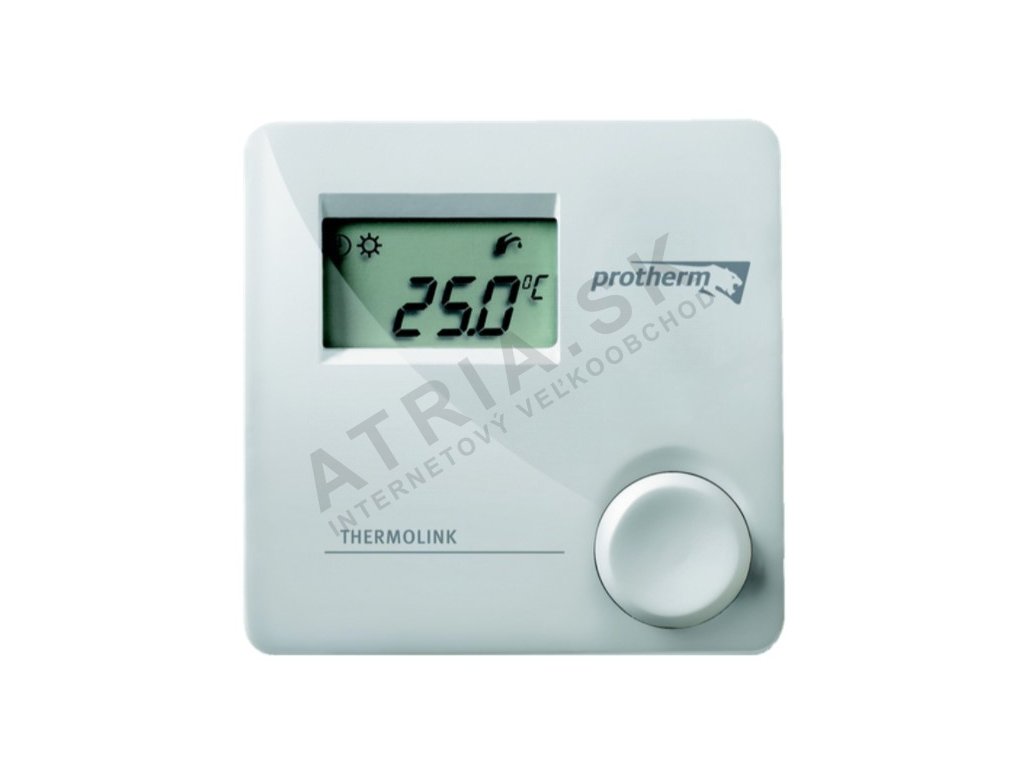
Protherm Thermolink B – a wired room controller with eBus communication for Protherm boilers.
Protherm belongs to the Vaillant Group, which means its boilers also use the eBus. Protherm Thermolink B is a wired room controller designed specifically for this platform. It offers programmable heating schedules, the option of connecting an outdoor temperature sensor and operation in weather-compensated mode – meaning it controls the heating water temperature on the basis of the outdoor temperature, not just the room temperature.
The Thermolink B is suitable for owners of Protherm Panther, Gepard, Tiger and other models with an eBus interface. Installation requires a 2-core cable to be run from the boiler to the controller – trivial in a new build, but in a renovation you need to think about the cable route.
Protherm Thermolink LUX – the wireless alternative

Protherm Thermolink LUX – a wireless controller for Protherm boilers, with no need to run cables.
For those who do not want to run cables or whose boiler is in a plant room far from the living area, Protherm Thermolink LUX is an elegant solution. The room unit communicates with the receiver at the boiler by radio, and the receiver is connected to the boiler's eBus. The result is the same functionality as the wired Thermolink B, but without any building work.
The Thermolink LUX can also be extended with an outdoor temperature sensor for wireless controllers (Outdoor temperature sensor for wireless controllers Thermolink LUX, RC, MiPro R, MiPro Sense R, MiSet R), which activates weather-compensated control in the wireless setup as well. This combination gives practically the same result as a fully fledged wired eBus controller – just without the cable.
Outdoor temperature sensor for Protherm boilers with an eBus

Protherm – Outdoor temperature sensor (wired) for boilers with an eBus – an essential add-on for weather-compensated control.
Weather-compensated control is impossible without an outdoor sensor – the boiler simply does not know what the temperature is outside unless something tells it. The wired outdoor temperature sensor for Protherm boilers with an eBus is a relatively inexpensive accessory (approx. €20–40) that is fitted to the north or north-west wall of the building (a shaded spot out of direct sunlight) and connected directly to the boiler or controller via the eBus.
Installation is undemanding, but the correct mounting position must be observed – the sensor must not be exposed to direct sunlight, rain or heat radiated from the building (e.g. close to a ventilation outlet). If the sensor is badly positioned, the control can be counterproductive.
For wireless controllers (Thermolink LUX and others) there is a separate version: Outdoor temperature sensor for wireless controllers Thermolink LUX, RC, MiPro R, MiPro Sense R, MiSet R.
NTC cylinder sensor – for controlling hot water preparation
The subject of thermostats for gas boilers is not limited to heating. If you have a hot water cylinder connected to the boiler, the temperature sensor in the cylinder is key to controlling it properly. The NTC sensor kit for cylinder 10 kΩ is a standard resistance temperature sensor that the controller uses to measure the water temperature in the cylinder and control heating accordingly. If the original sensor is damaged or inaccurate, the whole hot water system works badly – either the water is not heated enough or the boiler runs for needlessly long.
Weather-compensated control: why it is in a different league
Most people know only the simple logic of a thermostat: when it is cold I set a higher temperature, when it is warm a lower one. Weather-compensated control works differently – and far more efficiently.
The principle is as follows: the boiler receives information about the outdoor temperature (from an external sensor) and sets the temperature of the heating water in the circuit on that basis. The greater the difference between the required indoor temperature and the outdoor temperature, the higher the heating water temperature. When it is -15 °C outside, the boiler heats the water to 75–80 °C. When it is +5 °C outside, 45–55 °C is enough.
Why does this matter? Condensing boilers achieve their highest efficiency (up to 109 % based on net calorific value) precisely when the return temperature is low – ideally below 55 °C. If the boiler constantly heats the water to 80 °C (because it has no information about the outdoor temperature and you set it manually), the condensing effect is lost and the boiler behaves like a non-modulating one. Weather-compensated control automatically ensures that the boiler runs in condensing mode for as long as possible – and so saves gas.
Weather compensation curve: at higher outdoor temperatures the boiler heats the water to a lower temperature – so the condensing boiler runs more efficiently.
How much will you really save? Specific figures and examples
Thermostat manufacturers and retailers like to promise “savings of up to 30 %”. The real figures are more modest, but still attractive. It depends on your starting point – if you have had no thermostat at all so far and the boiler has been running at a fixed temperature 24/7, the saving after installing a programmable thermostat really can be 20–30 %. If you had an old bimetallic thermostat and replace it with a digital one with a programme, the real saving is 8–15 %. If you add weather-compensated control with an outdoor sensor, a further 5–10 %.
| Change scenario | Estimated saving | At €1,500 a year for gas | Payback period |
|---|---|---|---|
| No thermostat → digital programmable | 20–30 % | €300–450/year | within 3 months |
| Bimetallic → digital with a weekly programme | 8–15 % | €120–225/year | within 1 season |
| ON/OFF thermostat → eBus/OpenTherm controller | 8–12 % | €120–180/year | within 1 season |
| Adding a weather compensation sensor to an eBus controller | 5–10 % | €75–150/year | within 6 months |
| Smart thermostat with geofencing and learning | 3–8 % (compared with a good programmable one) | €45–120/year | 2–4 seasons |
An important note: these figures apply to condensing gas boilers, which are the standard today. If you have an old non-modulating boiler (from before 2000), weather-compensated control will not help you much – the boiler cannot modulate its output. In that case the biggest saving comes from programming (night setback, setback when nobody is at home).
A practical example: the Novák family from Bratislava
The Novák family has a 140 m² detached house, a Protherm Panther condensing boiler from 2018 and an old bimetallic thermostat permanently set to 21 °C. Their annual gas cost for heating is €1,800 (including hot water).
They decided to take three steps at once:
- Replace the bimetallic thermostat with a Protherm Thermolink B with eBus communication – price approx. €65.
- Connect a wired outdoor temperature sensor to activate weather-compensated control – price approx. €30.
- Set a weekly programme: 20 °C from 6:00 to 22:00, 17 °C at night, 17 °C during the day on working days (when nobody is at home).
The result after the first season: gas consumption fell by 19 % – from €1,800 to approx. €1,458. A saving of €342 for a total investment of €95 (thermostat + sensor). Payback: less than one month. Of course every house is different, but this scenario is not exceptional – it is typical of houses where the heating was not previously run “to the daily rhythm”.
Compatibility: how to find out which thermostat fits your boiler
This is the most common problem when buying a thermostat. People buy a thermostat, find out at home that it cannot be connected to their boiler, and return it. To avoid that, here is what to do:
Step 1: Find out the manufacturer and model of your boiler
The rating plate is usually on the bottom or side panel of the boiler. Note down the full model (e.g. Protherm Panther Condens 25 KKO).
Step 2: Find out which bus the boiler supports
- Protherm, Vaillant: eBus (a 2-wire bus – it is not 230 V!)
- Bosch, Junkers, Buderus: EMS / EMS+ or OpenTherm
- Viessmann: LON / OpenTherm / Vitocom
- Baxi, De Dietrich, Remeha: OpenTherm
- Ariston: Kai/Bus or OpenTherm
- Most also have conventional volt-free contacts (RT/RT)
Step 3: Decide what you want to achieve
If you only want basic programming without losing functionality, an ON/OFF thermostat on the volt-free contacts is enough – it works with all boilers. If you want full modulation and weather compensation, you need a thermostat with the appropriate bus.
Step 4: Check compatibility with the retailer
If you are not sure, contact the retailer with your boiler model – a good retailer (such as ATRIA) will recommend a specific product. Do not forget that the cables play their part too – some thermostats require a 230 V supply, while others run only on low voltage via the bus.
Installing a thermostat: what you can do yourself and what to leave to a professional
Installing a simple digital thermostat is usually undemanding and well within the abilities of a technically competent DIYer. With eBus or OpenTherm thermostats the situation is more complicated – you need to know which terminals on the boiler the cable goes to, and after installation the parameters in the boiler menu have to be set (activating the external controller). Some boilers may display a fault code if the wrong thermostat is connected.
The rule is simple: if you are doing it yourself, install an ON/OFF thermostat with a volt-free contact – it is safe (it works at 24 V or lower) and you cannot damage the boiler. With an eBus/OpenTherm thermostat, leave the installation and set-up to a service engineer. The cost of a call-out (€60–100) will quickly pay for itself when the thermostat works correctly from the start.
Important: no work on gas appliances (the boiler itself) may be carried out by unqualified persons – this applies to the mechanical side of the boiler, not to the electrical connection of the thermostat. The thermostat is only an electrical controller, not part of the gas installation.
The thermostat and hot water control: the forgotten side of saving
Most discussions about thermostats focus on heating. But a gas boiler combined with a hot water cylinder has another great potential for savings – control of hot water preparation.
Problems people do not deal with, but should:
- Cylinder temperature set too high: A cylinder set to 70–75 °C uses considerably more energy than a cylinder set to 55 °C with one weekly cycle at 70 °C (a hygiene cycle to eliminate legionella).
- Faulty cylinder sensor: If the NTC sensor in the cylinder measures the temperature inaccurately, the boiler heats the water for longer than necessary or, conversely, switches off too early. The NTC sensor kit for cylinder 10 kΩ is a relatively inexpensive replacement that can solve this problem.
- Heating at night: Some boilers heat the cylinder at unsuitable hours according to an internal programme. Moving hot water heating to the “cheaper” part of the day (e.g. in the morning before you leave) is simple and effective.
Legislation and standards in 2026: what you need to know
Since 2018 the EU Ecodesign Regulation (ErP) has prohibited the sale of boilers that cannot be connected to an external controller. Practically all boilers sold on the Slovak market after 2018 therefore have at least terminals for a volt-free thermostat, and most have a bus as well (OpenTherm or eBus). If you have an older boiler (pre-2018), you can still connect an external thermostat, but you can only dream of bus communication – you have to settle for an ON/OFF connection.
As regards grants in Slovakia: in 2025–2026 grants are available for boiler replacement under the ŠFRB and Zelená domácnostiam programmes. The thermostat itself is not eligible for a grant, but it is a mandatory part of the installation of a new condensing boiler (under the STN EN 15450 standard and the manufacturer's requirements for keeping the warranty valid). In other words: if you install a new boiler and do not fit a controller to it, you may lose the manufacturer's warranty.
The Energy Performance of Buildings Directive (EPBD) in its current wording also counts heating control as part of the energy class assessment – a building without working controls automatically receives a poorer rating, which in practice shows when the property is sold.
Frequently asked questions (FAQ)
Can I fit any thermostat to any boiler?
Technically – almost, yes, if it is a simple ON/OFF thermostat connected to the boiler's volt-free contacts. In practice – not every thermostat is compatible with every bus. You cannot connect an OpenTherm thermostat to an eBus boiler, and vice versa. Always check compatibility against the boiler model. If you are not sure, choose a thermostat of the same brand as the boiler – that is the safest route.
Is a wireless thermostat worth it instead of a wired one?
If you can run a cable without difficulty, a wired one is cheaper and more reliable (no problems with batteries or interference). If that is not possible or you want flexibility in where it goes, a wireless one is an excellent alternative – just make sure it uses the same protocol as the boiler (e.g. Protherm Thermolink LUX for Protherm boilers).
What is night setback and is it worth setting?
Night setback is a reduction of the required temperature at night (typically 17–18 °C instead of 21 °C). Yes, it is worth it – every degree less represents a saving of roughly 6 %. With 4 hours of night setback by 3 °C, that is around 3–5 % of annual savings. Be careful, though: in a well-insulated house with high thermal inertia, warming up in the morning can take longer – in that case a thermostat with “comfort preheat” (automatic calculation of when to start heating so that the room is warm at the set time) is more suitable.
Can a thermostat damage the boiler?
An incorrectly wired thermostat (e.g. feeding 230 V to terminals intended for 24 V or eBus) can damage the boiler's electronics. That is why it is important to know what voltage is present at your boiler's terminals and to wire the thermostat according to the instructions. A correctly wired thermostat will not damage the boiler – on the contrary, it reduces the number of on/off cycles, which extends its service life.
Is a smart thermostat (Wi-Fi, app) worth it compared with a conventional programmable one?
It depends on your lifestyle. If you have a regular daily routine and simply set a weekly programme, a conventional programmable thermostat for €50–80 will save you just as much as a smart thermostat for €200. A smart thermostat makes sense if you have an irregular schedule, travel, want to change settings remotely or are planning integration with a smart home. In that case the difference in convenience and the additional saving (5–8 % compared with a well-set conventional thermostat) are worth it.
What is a weather compensation curve and do I have to set it manually?
The weather compensation curve defines how the heating water temperature depends on the outdoor temperature. In most controllers it is preset by the manufacturer (a flatter curve for underfloor heating, a steeper one for radiators). The service engineer will set the right curve for you during installation – it depends on the type of heating system, the size of the house and the design temperature drop. Once it is set correctly, there is no need to adjust the curve manually – the controller takes care of it by itself.
Conclusion: so what really saves money
To finish, let us sum up without the marketing noise. A thermostat for a gas boiler is not a miracle device, but it is one of the few measures with an immediate and measurable return on investment – usually within one heating season.
The biggest saving comes from these sources, in order of importance:
- Programming (weekly schedule): You heat when it is needed. Not when it is not.
- Sensor accuracy: You do not heat to 23 °C when you want 20 °C.
- Weather-compensated control: The condensing boiler runs efficiently instead of just switching on and off.
- Correct setting of the domestic hot water (DHW) cylinder: Temperature, heating time, a working sensor.
If you have a Protherm boiler, go for the Protherm Thermolink B (wired) or the Protherm Thermolink LUX (wireless) – and do not forget to connect an outdoor temperature sensor for full weather compensation. If you have a Vaillant, the Vaillant VRT 50 is a proven and reliable choice.
At today's gas prices, investing €60–120 in the right thermostat and sensor is a decision that will pay for itself before the first winter is over. And unlike insulating the façade or replacing the windows, a thermostat needs no planning permission, an installer will fit it in an hour and the result shows on your very next bill.
Do you have a question about this topic?
Can't decide, or dealing with a specific situation in your home? Write to us – we will be glad to advise.