
Karma Gamat S 50
Code: GAMAT S 50Product detailed description
Gas stove Karma Gamat S 50
-
stove output 5.3 kW
-
suitable for rooms with a volume of up to 100 m³
-
thermostat temperature control
-
resistant to freezing
-
high stove efficiency
-
high operating safety
-
enamelled heat exchanger
-
chimney sensor (microswitch) - backdraught safety cut-off
-
gas valve with a thermoelectric safety cut-off
-
floor-standing installation
-
flue gases are led into the chimney via the right, left or rear outlet (as needed)
-
stove casing made of steel sheet protected by special powder coating
-
the standard stove colour is ivory
- A = 566 mm
- B = 198 mm
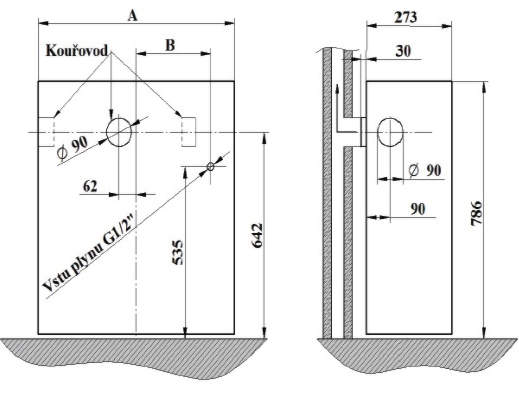
| Technical data | GAMAT S50 |
| Weight (kg) | 33 |
| Grille colour on the stove | brown |
| Heat exchanger | enamelled |
| Temperature selector | 13 to 38 °C |
| Electrical connection | not required |
| Gas connection | G 1/2 |
| Outer dimensions - w x d x h | 566 x 273 x 786 |
| Stove suitable for rooms with a volume of (m3) | up to 100 |
| Heat output, max. | 5,33 |
| Heat input, max. | 6,10 |
| Natural gas consumption (m³/h) | 0,63 |
| Consumption - propane-butane (kg/h) | 0,48 |
| Flue gas outlet diameter | 90 |
Frequently Asked Questions
- How do I choose the right output for a KARMA gas stove? Just as with gas boilers, base your choice on the calculated heat loss of the heated space. For electric heaters it is also essential to check whether your home's electrical connection can support it - higher outputs (roughly above 12 kW) usually require a three-phase 400 V connection and a correspondingly sized main circuit breaker, which your electrical inspector or the electricity distributor can confirm.
- Is an electric boiler worth it compared to a gas or solid-fuel boiler? An electric boiler has the lowest purchase price and the simplest installation (no flue is needed, since nothing is combusted), but running costs on electricity are usually higher than gas or wood/coal for the same amount of delivered heat. It is best suited where gas is not available, as a supplementary/backup source, or for a low-consumption building (well-insulated new builds, cottages, apartments).
- How does an electric boiler regulate output? Most models switch the individual heating elements on/off in stages, while some more modern models also allow smoother output modulation - this affects heating smoothness and, to some extent, the lifespan of the switching components.
- Can I install this electric boiler myself? Connection to the electrical grid, inspection and commissioning must be carried out by a person with electrical qualification in accordance with the applicable STN 33 2000 standard and related regulations - self-installation is not permitted, either for warranty reasons or for safety reasons.
- Can this electric boiler also heat domestic hot water? For many models, yes - usually in combination with a separate hot water tank and a switching (3-way) valve that switches between the heating circuit and heating the tank. You can find the exact option and required accessories for this specific model in the technical parameters above, or consult our customer service.
Additional parameters
| Category: | flue gas discharge into the chimney |
|---|---|
| Warranty: | 2 years |
| Weight: | 10 kg |
| Stove heat output: | 5,3 kW |


Product rating
Be the first who will post an article to this item!
Discussion
List of discussions
 pavol
atria
vojtech
atria
 svetlana
atria
jan
atria
ondrej
atria
peter
atria
renata
atria
About the company
Karma is the largest manufacturer of convection gas stoves in the Czech Republic. The company continues its tradition, which was founded as early as 1910. In June 2006, Karma acquired the German brand of heating stoves Gamat – a brand known as "vafky"
History and present
Karma is synonymous with gas appliances. The name Karel Macháček, one of the most successful and most famous manufacturers, is closely linked to the beginnings of gas industry on the territory of the Czech Republic. Karel Macháček was the first to start mass production of high-quality gas appliances almost 100 years ago. He gave them a brand composed of the initial syllables of his first name and surname.
At the beginning of the 20th century, there was no Czech manufacturer of gas appliances for households. These appliances were supplied to Bohemia by foreign companies – mainly Siemens and Junkers. While in Budapest and Vienna the use of gas appliances for cooking, hot water preparation and ironing was quite widespread and gas industry was on the rise, in Prague there was a decline in this area. It was mainly caused by the arrival of electricity, which started to push gas out of street and apartment lighting. The use of gas was at a historical turning point and the idea of reconstructing gasworks was considered only later.
However, in Prague at that time, an unprecedented construction activity was taking place. Entire streets and blocks of new houses in suburban areas on both sides of the Vltava River were growing like mushrooms after rain, and a modern large Prague was emerging. In the new apartments at that time, gas pipelines were installed not for lighting, but for cooking and baking, for heating water and gradually even for heating. These circumstances were correctly identified and understood by a young enterprising man who knew that a half-million Prague could not exist for long without a factory and repair workshop for gas appliances. Therefore, he established a factory in Vysočany in 1910, where he started producing this range. That young man was none other than Karel Macháček.
Český Brod welcomes you
In an effort to free himself from dependence on foreign subcontracting foundry castings, Karel Macháček built his own modern foundry according to the example of American car manufacturers. When gas production was launched in the new gasworks in Michle with a large production capacity in 1927, a new modern Macháček factory was already standing in Český Brod. Macháček had this factory built to meet the constantly increasing demand from gas consumers for new stovetops, irons and stoves with a tool workshop, pressing machines, sand blasting equipment and a drum, as well as his own enameling workshop with two muffle furnaces. The factory in Libná continued to serve exclusively for the production and repairs of water heating appliances with output from 2 to 30 l/min. Here the factory had its own test laboratory, chromium plating, nickel plating and painting workshop with modern spraying equipment.