
Frequently Asked Questions about Solar Systems and Collectors
Solar water heating systems belong to the topics we talk about a lot, yet it's often difficult to find a clear and concise answer to a specific question. Customers keep asking the same things over and over – what is the difference between flat and vacuum collectors, why they need a special solar storage tank, how the pump control works exactly, which type of pipe to use for the roof distribution, how to mount the collectors on different types of roofs, or why the solar circuit has its own expansion vessel. In this article, we have gathered the most frequently asked questions about solar systems and collectors and answer them clearly, with references to more detailed topics and specific products.
A solar system for heating domestic hot water (a solar thermal system) is an investment that pays off especially well if your roof is oriented to the south, southeast or southwest and there is enough free space for the collectors. It is not a miraculous solution that replaces a boiler or heat pump – it is a supplement that can significantly reduce the load on the main heat source, especially during the warmer months of the year. That is why it is important to understand what you can realistically expect from such a system and how the individual components work together.
Below you will find answers divided into thematic areas – from the principle of operation through the selection of collector type, storage tank, control, piping, up to mounting on the roof and filling the circuit. At the end of the article, there is also a separate FAQ section with short answers to additional questions and two real-life examples from practice.
What exactly is a solar water heating system and what can I expect from it?
A solar system consists of four basic components that work together.
A solar water heating system (a solar thermal system) consists of four basic parts: solar collectors mounted on the roof, which capture solar radiation and heat the heat transfer fluid (a mixture of water and antifreeze), a solar storage tank with a heat exchanger, a pump unit that ensures the circulation of the fluid between the collector and the tank, and a control unit that automatically manages the entire process.
It is important to emphasize one thing right from the start, which almost every customer asks about: a solar system complements the main heat source – that is, a gas or condensing boiler, a heat pump or an electric boiler – it does not fully replace it. It can cover the need for heating domestic hot water to the greatest extent in the summer months, when there is enough solar radiation and the outside temperatures are high. In the winter months, when there is little sunlight and the outside temperatures are low, the solar system contributes to water heating only partially, and the main work is still done by the boiler or another heat source.
If you are considering whether a solar system is worth it for you and which type of system to choose for your house, we recommend reading the detailed guide How to choose a solar water heating system, where you will find a complete step-by-step process including recommendations according to the size of the household and the orientation of the roof. If you are considering combining solar heating with an existing boiler, also check out the topic Solar heating as a supplement to a boiler, where we explain how both devices work together throughout the year.
What is the difference between flat and vacuum collectors and which ones to choose?
This is probably the most frequently asked question we hear from customers. On the market, there are basically two types of solar collectors – flat and vacuum (tube) – and each has its advantages and limitations.
Comparison of two basic types of solar collectors.
Flat collectors have an absorber surface covered with tempered glass, placed in an insulated aluminum frame. They are structurally simpler, mechanically more durable – for example, against hail or mechanical impact – and generally cheaper than vacuum collectors. In our climatic conditions, they usually fully suffice for heating domestic hot water and are therefore the most common choice for single-family homes.
Vacuum (tube) collectors achieve higher efficiency especially at low outside temperatures and at lower intensity of solar radiation – that is, during periods when flat collectors already lose performance. This property is advantageous especially where solar energy is planned to be used outside the summer season, for example for partial support of heating. The disadvantage is the higher purchase price and greater fragility of the structure compared to flat collectors.
Therefore, the choice between the two types is not a question of "which is better" in general, but rather a question of what exactly the system is intended for and what the budget is. A complete comparison with specific recommendations can be found in the article Flat vs. vacuum solar collectors.
Why a solar storage tank is not just an additional regular water heater?
Another common question is: "Can I use a regular water heater, or do I really need a special solar storage tank?" The answer is clear – a solar storage tank has at least one heat exchanger in addition to a standard water heater, which is connected to the solar circuit. Very often, such a tank even has two heat exchangers – one for the solar circuit and one for boosting the temperature with a boiler, when solar energy is not sufficient to heat the water.
The principle is indirect heating: the water intended for consumption (hot domestic water) is heated indirectly, through the wall of the heat exchanger. The solar fluid itself circulates separately, in a closed circuit, and never comes into direct contact with the domestic water, which you might turn on in the bathroom. This separation is also important from a hygiene point of view, since the heat transfer fluid contains an antifreeze component, which should not be found in drinking water.
When choosing the correct size and configuration of the tank (number of heat exchangers, volume according to the number of people in the household), it is worth proceeding systematically – a detailed guide can be found in the article What solar storage tank do I need?.
How does the control of the solar circuit work and when does the pump really start?
A solar system is not running continuously – that would not make sense, since at night or on a cloudy day, the pump would only circulate cold fluid unnecessarily and would remove heat from the tank instead of delivering it. That is why every solar system has a control unit.
The control (solar) unit compares the temperature on the collector and the temperature in the tank using sensors. When the collector is warmer than the tank by a pre-set difference (typically a few degrees Celsius), the unit turns on the circulation pump of the solar group and heat starts to be transferred to the tank. When the difference is too small or the tank is warmer than the collector – for example at night – the pump remains off.
The actual circulation is physically handled by the pump unit (often also called a solar pump group or solar station). It contains the circulation pump, shut-off valves, thermometers and manometers for monitoring operating values, and a safety valve in case of excessive pressure. All these components are usually grouped in one compact block, which greatly simplifies installation and later service, since the technician does not have to look for individual parts scattered throughout the circuit.

Solar regulation (control unit), which compares the temperature of the collector and the tank and switches the circulation pump of the solar group according to the set difference.
Price: 108.94 €

Complete pump group – circulation pump, shut-off valves, manometers and a safety valve in one compact block for the circulation of the solar fluid between the collector and the tank.
Price: 750.55 €
If you are interested in more detailed information on how exactly the control units and pump groups work, what settings they have and what to watch out for when choosing, read Control units and pump groups of solar systems.
What kind of piping to use for the distribution between the collector and the technical room?
The distribution between the solar collectors on the roof and the technical room, where the tank and the pump unit are located, can be solved in two basic ways. The first is the classic copper or stainless steel piping, which is installed to measure and then insulated with heat insulation resistant to high temperatures and UV radiation (since part of the piping may run along the external façade or roof).
The second option is pre-insulated flexible pipe 2 in 1 – a flexible twin pipe, in which the supply and return are led in one already insulated sheath. A big advantage of this solution is the reduced installation time, since nothing has to be additionally insulated directly on the roof or in the shaft – the pipe is simply pulled from point A to point B and that's it. For more complex routes with multiple bends or longer distances, this saves installers a significant amount of time.
The connecting element between rigid piping and individual components (collector, pump unit) is often a flexible stainless steel pipe, so-called corrugated pipe. Thanks to its flexibility, it compensates for minor inaccuracies during installation and is resistant to high temperatures that the solar fluid can reach in summer under full sunlight.

Stainless steel pipe, corrugated pipe
Flexible stainless steel pipe for distribution between the collector and the tank, resistant to high temperatures of the solar fluid.
Price: 3.81 €
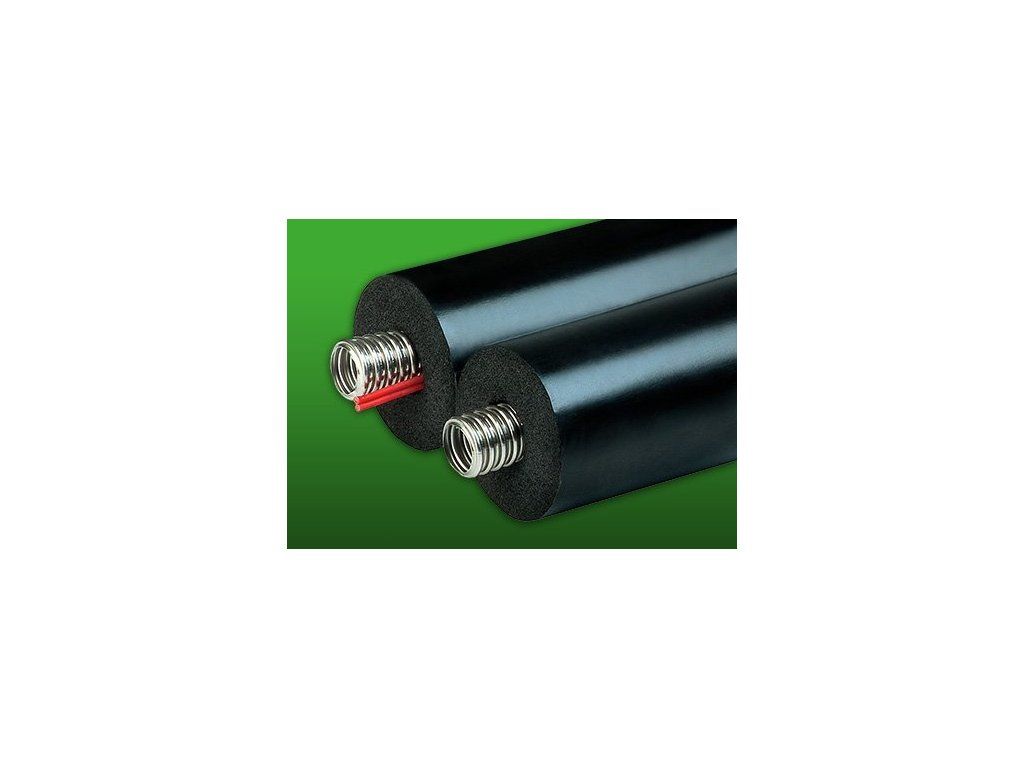
Solar flexible pipe 2 in 1, 10 m
Pre-insulated, flexible twin pipe (supply and return in one sheath) for quick installation of the distribution between the collector and the technical room.
Price: 308.75 €
More about both solutions, including when it is worth going for classic piping and when for flexible pipe, can be found in the article Solar piping and stainless steel corrugated pipes – how they work.
How are collectors mounted on different types of roofs?
Another practical question that almost every interested person asks before the actual purchase: "Can it be mounted on my roof?" The answer depends on the type of mounting structure, which is chosen precisely according to the type of roof and type of collector.
On a sloped roof, collectors are mounted using a structure adapted to the specific roofing material – tiles, metal roofing or corrugated sheeting require different brackets, since the way they can be safely fastened to the roof without damaging the roofing material differs. On a flat roof, an adjustable structure is used, which sets the slope of the collector – usually at least 15° – which is important mainly for the self-cleaning of the collector surface by rainwater. Without sufficient slope, dirt could accumulate on the collector over time and reduce its efficiency. A third option is mounting on the façade or directly on the ground, which is used where the roof is not suitable for various reasons (wrong orientation, shading, structural issues).
In all cases, one important rule applies: the mounting structure must exactly match the dimensions of the specific type and model of the collector. It is not a universal part that "fits everything" – when ordering, you must always check that the structure is intended precisely for your collector model and roof type.

Mounting kit for flat roof collectors up to 15° slope, for collector KS 2100F 1.82 m²
Mounting structure for attaching a flat collector to a flat roof, with adjustable slope.
Price: 117.34 €
A detailed overview of mounting options for all types of roofs and facades can be found in the article Mounting of collectors – sloped roof, flat roof, facade.
Why does the solar circuit have an expansion tank and how is it filled/ventilated?
The solar circuit is a closed pressure system – similar to the heating circuit in a house. Since the heat transfer fluid can reach high temperatures on sunny days, its volume increases when heated. To prevent this volume expansion from causing uncontrolled pressure increases in the circuit, an expansion tank is part of the system, which compensates for this volumetric expansion.
Filling and venting the solar circuit is done similarly to a conventional heating circuit – through filling valves, using a manual or electric filling pump. The liquid is pumped into the circuit under pressure, while air is simultaneously pushed out of the circuit, which could otherwise cause air bubbles that hinder proper circulation and heat transfer. This operation is performed during the first installation and also during regular maintenance, since the heat transfer fluid degrades over time and must be replenished.
The complete step-by-step installation process, including filling and venting, can be found in the article Installation of a solar system – step by step. If you are dealing with an existing system and want to know what to do during maintenance or if you suspect a fault, see Maintenance, filling and common faults of solar systems.
Real examples from practice
The prices of individual components of the solar system vary significantly.
Example 1 – a family house with an older gas boiler. A family house for a four-person family, a gable roof oriented to the southwest, covered with tiles. Until now, the heating of hot domestic water was exclusively provided by the gas boiler, which in the summer months meant unnecessarily high gas consumption just for heating water for showering and regular use in the kitchen and bathroom. After adding a solar system with flat collectors, a solar storage tank with two heat exchangers, a control unit and a pump group, the heating of hot water in the summer months was almost entirely transferred to the solar system – the boiler is activated only occasionally during this period, for example during longer periods of cloudy weather. Outside the summer season, the solar system still contributes partially, but the main load is taken over by the boiler, exactly as this combination is usually designed.Example 2 – a weekend cottage with seasonal use. A cottage used mainly during weekends and summer months, without year-round heating, with a flat roof. Since the building is not continuously occupied and the owners wanted a simple and reliable solution without the need for complex control, they chose a smaller solar system with flat collectors on an adjustable structure for a flat roof (slope set to the recommended 15° for self-cleaning), a smaller solar storage tank and a compact pump unit. The control unit automatically turns the pump on and off without the need for owner intervention – when they arrive at the cottage, they only find hot water prepared from the accumulated heat of previous sunny days. Due to seasonal use, it was crucial for them that the entire system works reliably without the need for regular presence of the operator.
Most frequently asked questions about solar systems
Can a solar system fully cover water heating without a boiler?
No, a solar system complements the main heat source (boiler, heat pump), it does not fully replace it. At most, it can cover the need for heating hot domestic water in the summer months when there is enough sunlight. In other periods of the year, the main heat source continues to heat the water.
Is it better to choose flat or vacuum collectors?
For regular heating of hot domestic water in our climatic conditions, flat collectors are usually sufficient – they are cheaper and more mechanically durable, for example against hail. Vacuum collectors have the advantage of higher efficiency at low external temperatures and lower intensity of solar radiation, but they are more expensive and fragile. The choice depends on the specific purpose and budget.
Why can't I use a regular water heater instead of a solar storage tank?
A solar storage tank has at least one heat exchanger connected to the solar circuit, through which the water is heated indirectly. The solar fluid circulates separately in a closed circuit and does not come into contact with the domestic water. A regular water heater does not have this function.
How do I know that the solar pump group starts at the right time?
The control unit automatically turns the pump on according to the temperature difference.
This is taken care of by the control unit, which compares the temperature on the collector and in the tank using sensors. When the collector is warmer than the tank by the set difference, the unit automatically turns on the circulation pump. There is no need to switch anything manually.
What is the difference between classic pipe and Flexi 2in1 pipe?
Classic copper or stainless steel pipe is installed to measure and insulated additionally on site. The pre-insulated Flexi 2in1 pipe has both the supply and return in one already insulated flexible casing, so no additional insulation is required – this reduces installation time, especially for more complex routes.
Can a solar system be installed on any roof?
Collectors can be mounted on a sloped roof (various types of roofing – tiles, sheet metal, corrugated metal), a flat roof (adjustable slope, usually at least 15° for self-cleaning) or on a façade or ground. The construction must always exactly match the dimensions of the specific collector type.
Why does the solar circuit need an expansion vessel?
The solar circuit is a closed pressure system and the heat transfer fluid expands in volume at high temperatures. The expansion vessel compensates for this expansion to prevent uncontrolled pressure increases in the circuit.
How is the solar circuit filled and vented?
Similarly to the heating circuit – via filling valves using a manual or electric filling pump. Air is simultaneously pushed out of the circuit during filling to prevent air bubbles from forming, which could hinder the flow and heat transfer.
Related topics
- How to choose a solar system for water heating
- Flat vs. vacuum solar collectors
- What solar storage tank do you need
- Solar piping and stainless steel corrugated tubes – how they work
- Control units and pump sets for solar systems
- Mounting collectors – sloped roof, flat roof, façade
- Solar heating as a supplement to a boiler
- Installation of a solar system – step by step
- Service, filling and common faults in solar systems
Do you have a question about solar systems or collectors?
Struggling to decide or dealing with a specific situation in your home? Write to us – we are happy to help.