
Circulation pumps: how to choose the right output and type for your heating system
The circulation pump is the heart of every modern heating system. Without it, hot water from the boiler simply would not reach every radiator in the house in time – or it would get there too late and with too much heat lost on the way. Even so, when refurbishing their heating or replacing a pump, most people reach for the first available unit of “similar output” and hope for the best. The result? Either a noisy pump that runs flat out and wastes electricity, or an undersized unit that cannot supply the most distant radiators.
In this article we explain everything you need to know about circulation pumps – from the basic physical principles, through correctly calculating the duty you need, to specific recommendations for different types of home. A correctly chosen pump can save tens or even hundreds of euros a year in electricity in 2026, whereas a badly chosen one will quietly “steal” money from you every day of the heating season.
What is a circulation pump and why does it matter so much?
A circulation pump (also called a circulator) is a small electrical device whose job is to force the heating system water to circulate in a closed circuit. The boiler heats the water, the pump drives it through the pipework to the radiators (or underfloor heating), where the water gives up its heat and, once cooled, returns to the boiler to be reheated.
Without a pump, only so-called gravity circulation would work – warmer water rises (it is lighter) and cooler water sinks. The principle does work, but it is slow, imprecise and practically unusable for modern low-temperature systems. That is why circulation pumps have been standard in every heating system since the 1960s.
In 2026, new circulation pumps sold in the EU are subject to the ErP (Energy-related Products) regulation, which sets a minimum level of energy efficiency. Pumps must achieve an energy efficiency index of EEI ≤ 0,23. In practice this means that all new pumps must be so-called “ECO” or “High Efficiency” types with an electronically controlled motor. The old generation of single-speed and three-speed glandless pumps may no longer be sold in the EU as new equipment.
Types of circulation pump – a market overview for 2026
Before we get into the calculations, let us look at the main types of pump you may come across:
1. Standard glandless (wet rotor) pumps – three-speed
These are the classic pumps you will know from homes more than 15–20 years old. The motor is immersed directly in the pumped fluid (hence “wet rotor”), so the water itself lubricates the bearings and cools the motor. These pumps generally have three fixed speeds – you change them manually with a switch according to the heating demand. Their drawback is that they cannot respond automatically to the changing needs of the system. When you close the thermostatic radiator valve on one radiator, the pressure in the system rises, but the pump still draws just as much electricity.
These models have not been allowed to be sold in the EU as new standalone units since 2015 (or since 2020 for pumps in boilers), but you may come across them when servicing older installations. Their typical consumption is 50–100 W.
2. High-efficiency ECO pumps with a PM motor
The modern standard. These pumps use an electronically commutated permanent magnet motor (PM motor or EC motor). Their main advantage is the ability to vary the speed continuously to match the current demand of the system. When most of the thermostats close their valves (for example overnight, when less heating is needed), the pump automatically reduces its output and consumption.
The typical consumption of these pumps is 3–45 W (depending on load), a saving of 50–80 % in electricity compared with the old models. For an average house with a 200-day heating season and continuous operation, this can amount to a saving of 80–150 kWh a year, which at current electricity prices in Slovakia (approx. 0,19–0,25 €/kWh in 2026) means 15–37 € a year – on the pump alone.
3. Pumps for domestic hot water (DHW circulation pumps)
A special category – these pumps do not circulate heating water but domestic hot water (DHW) in the pipework between the cylinder and the outlets. Their purpose is to spare you a minute's wait for hot water at the tap – the pump keeps it circulating constantly (or starts circulation according to a timer or motion sensor).
A typical example of such a pump is the WILO Z 20/1, a compact, quiet pump designed specifically for hot water circulation. It suits flats and houses where the DHW pipe run is longer than 5–6 metres and waiting for hot water is a nuisance.

WILO Z 20/1 – a compact DHW circulation pump, ideal for flats and smaller houses
Key parameters of a circulation pump – what do the numbers mean?
When you look through a pump catalogue, you will come across several parameters. Let us explain them properly once and for all, so that you know what you are buying.
Flow rate (Q) – volume of water per unit of time
The flow rate expresses how much water the pump moves per hour or per minute. It is given in m³/h or l/h and is one of the two most important parameters. Too low a flow rate means the distant radiators get too little heat. Too high a flow rate needlessly increases resistance in the system and noise in the pipes.
Head (H) – pressure difference
The head (also called the delivery head or pump head) expresses the pressure difference the pump can generate. It is given in metres of water column (m w.c.) or in bar (1 m w.c. ≈ 0,1 bar). This value determines whether the pump can overcome the hydraulic resistance of the entire system – the length of the pipes, elbows, valves, thermostatic heads, mixing valves and so on.
What do the numbers in the pump's name mean?
Manufacturers (including WILO) usually encode the parameters directly in the product name. For example, RS 25/4 means: connection diameter 25 mm (1 inch), maximum head 4 m w.c. The RS 25/6 model therefore has a maximum head of 6 m w.c. with the same connection. The number after the slash (4 or 6) is thus simply the pump's maximum H.
The number 130 or 180 on a model denotes the pump's port-to-port length in millimetres – the distance between the centres of the connecting threads. This is a critical dimension when replacing an old pump with a new one: you must keep the same port-to-port length, otherwise the pump will not fit into the existing pipework without alterations.
How do you calculate the circulation pump duty you need?
This is the core of the whole article. The calculation is not rocket science, but it does need a few input values. Let us go through it step by step.
Diagram for calculating the required flow rate and head of a circulation pump
Step 1: Find out the heat output of your boiler
The boiler's heat output is given in its data sheet or on the rating plate – for example 12 kW, 18 kW, 24 kW or 32 kW. If you do not know the boiler, you can estimate the output needed from the size of the house: a rough figure for a well-insulated house is 50–70 W/m², for an older insulated house 80–100 W/m², and for an uninsulated older house as much as 120–150 W/m².
Step 2: Determine the temperature difference
The temperature difference (Δt) is the difference between the flow and return water temperatures. Conventional radiator systems use 80/60 °C (Δt = 20 °C), modern condensing boilers 70/50 °C (Δt = 20 °C) or even 55/45 °C (Δt = 10 °C), and underfloor heating typically 45/35 °C (Δt = 10 °C). If you do not know, assume Δt = 15–20 °C for radiator heating.
Step 3: Calculate the required flow rate Q
The formula is simple:
Q [m³/h] = P [kW] / (1,16 × Δt [°C])
where 1,16 is the specific heat capacity of water converted to suitable units (kWh/m³·K). Example: 20 kW boiler, Δt = 15 °C → Q = 20 / (1,16 × 15) = 20 / 17,4 ≈ 1,15 m³/h.
Step 4: Estimate the required head H
The head depends on the hydraulic resistance of the whole system. For a rough calculation the rule is: total length of the longest circuit (in metres) × 0,10 to 0,15 m w.c. per metre of pipe. The short version: for a house with simple pipework allow H = 2–4 m w.c., for a larger house with longer circuits H = 4–6 m w.c., and for more complex systems with many thermostats and valve groups H = 6–8 m w.c.
If you have a design for the heating system (or it was prepared by a professional), the pressure loss should be calculated precisely there. If not, use the rough calculation and always choose a pump with a slightly higher head than the result – ECO pumps with variable speed control adjust themselves to the correct duty point and will not overpump.
Practical examples – which pump for which house?
Guide table for choosing a circulation pump by property size and boiler output
Example 1: Flat in an apartment block, long wait for hot water
The owner of a three-room flat in Bratislava complains that she has to wait 1,5 minutes for hot water to come out of the tap. She has a central hot water cylinder 12 metres from the bathroom. The solution is to install a small WILO Z 20/1 circulation pump with a timer set to run in the morning (6:00–8:00) and evening (17:00–22:00). The pump uses only 4–8 W, so running costs are minimal (approx. 2–4 € a year), while comfort improves dramatically.
Example 2: 130 m² house, replacing an old pump
A gentleman from Žilina has a house built in 1998 with an 18 kW gas boiler and 8 radiators. His old pump (three-speed, 75 W consumption) has just given up after 22 years. He wants to replace it himself, without any building work. First step: he measures the port-to-port length of the old pump – it comes to 180 mm. Calculation: Q = 18 / (1,16 × 15) = 1,03 m³/h. The longest circuit is an estimated 45 m → H = 45 × 0,12 = 5,4 m w.c. The right choice: WILO RS 25/6, 180mm – it covers the required flow rate and head, it is a modern ECO pump with a typical consumption of 5–20 W (against the old 75 W) and it fits straight into the place of the original unit.

WILO RS 25/4 (180 mm) – a modern ECO pump for houses, with a port-to-port length of 180 mm
Example 3: 90 m² new build with a condensing boiler
A young family from Nitra is building a 90 m² energy-efficient house. A 12 kW condensing boiler, underfloor heating on the ground floor, radiators upstairs. The underfloor heating runs at 40/30 °C (Δt = 10 °C), the radiators at 70/50 °C. They have two circuits – each needs its own calculation. For the underfloor circuit: Q = 8 kW / (1,16 × 10) ≈ 0,69 m³/h, H = 3 m w.c. For the radiator circuit: Q = 4 kW / (1,16 × 20) ≈ 0,17 m³/h, H = 2 m w.c. Both circuits are covered by the WILO RS 25/4, 130mm – a compact, quiet solution for a system with a short port-to-port length.
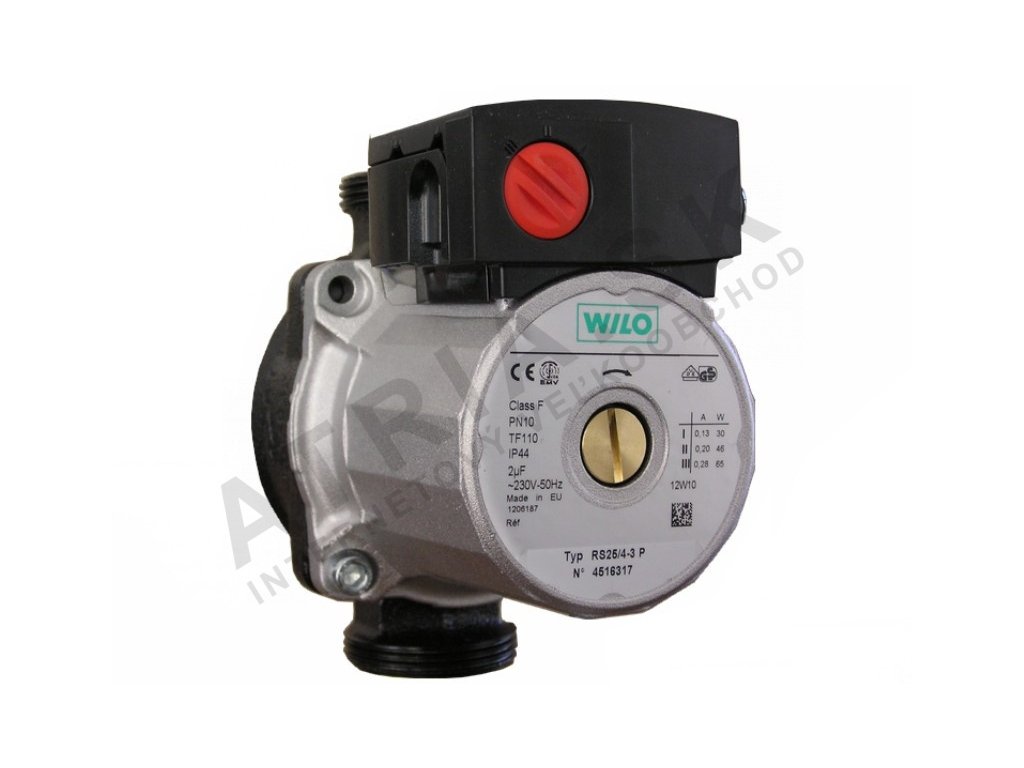
WILO RS 25/4 (130 mm) – a compact pump with a shorter port-to-port length, suitable for new builds and modern boilers
Port-to-port length 130 mm vs. 180 mm – what matters
One of the most common mistakes when replacing a pump is getting the port-to-port length wrong. If your system has a pump with a port-to-port length of 180 mm and you buy a 130 mm model, it simply will not fit – or rather it will have to be fitted with an adaptor, which complicates installation. And vice versa.
How do you find the port-to-port length of your pump? Measure the distance from the centre of one connection to the centre of the other (centre to centre). If you measure about 130 mm, look for a replacement with a port-to-port length of 130 mm. If about 180 mm, look for 180 mm. Most houses from the 1980s and 1990s have pumps with a port-to-port length of 180 mm installed. Newer installations and boilers with an internal pump (e.g. compact combi boilers) may also have 130 mm.
In our range you will find both the WILO RS 25/4, 180mm and the WILO RS 25/4, 130mm, with identical hydraulic parameters (flow rate Q and head H = 4 m) – they differ only in port-to-port length. The same applies to the more powerful model: the WILO RS 25/6, 130mm versus its 180mm sibling.

WILO RS 25/6 (130 mm) – a more powerful model with H = 6 m w.c., suitable for larger houses and more complex pipework
Operating modes of modern pumps – how to set them correctly
Modern ECO pumps in the WILO RS series offer several operating modes, which you can switch between simply using the button on the pump or via a mobile app (on some models):
- Constant speed (I, II, III) – the pump runs at a fixed speed setting. Suitable if you have a simple system without thermostatic radiator valves and need predictable behaviour.
- Constant pressure (CP) – the pump maintains a constant differential pressure regardless of how many thermostats are open. Suitable for systems with thermostatic radiator valves, where the number of open circuits changes.
- Proportional pressure (PP/ΔP-v) – this is the most economical mode and the right one for most modern systems. The pump reduces the pressure in proportion to the fall in flow rate (as the thermostatic radiator valves close). The result: minimum energy consumption and no noise in the pipes.
- AUTO mode – smart pumps (such as the WILO Z NOVA) work out the optimum duty point for themselves and adjust to the current demand of the system.
For an ordinary house with thermostatic radiator valves on the radiators, we recommend setting proportional pressure (PP) or AUTO mode. This will save you 30–50 % of the electricity compared with running at constant pressure.
Chart comparing the energy consumption of a circulation pump in different operating modes
Installing a circulation pump – what you need to know beforehand
A competent DIYer can replace a circulation pump unaided, but a few important rules apply:
Installation position
A circulation pump must be installed so that the rotor shaft is horizontal. This means the terminal box (the electrical part) must face upwards or sideways, never downwards. The motors of modern pumps are designed for specific installation positions – the wrong position can lead to rapid bearing wear and a shorter service life.
On the flow or the return?
The professional answer: the pump belongs on the return pipe, i.e. on the cooler side (water coming from the radiators, before it enters the boiler). The reasons: the lower water temperature extends the life of the seals and bearings, and there is less risk of cavitation (vapour bubbles forming in the pump). In practice many boilers have the pump built into the casing, in which case its position is not a matter for the installer.
Bleeding the system
Always bleed the whole system after replacing the pump. Air in the pipework is the pump's enemy – it causes noise (the typical “humming” or “gurgling”) and reduces performance. Modern WILO RS series pumps have a vent screw right on the front of the pump body – just loosen it briefly until water runs out with no bubbles.
Electrical connection
Circulation pumps are normally connected to 230 V / 50 Hz. When replacing one, switch off the circuit breaker and check that there is no voltage at the terminals. The wiring is simple – L, N, PE. If your pump is controlled by a signal from the boiler controls (for example via a “Pump” terminal or a relay), check the new pump's manual for how to wire the external control correctly.
A noisy pump – causes and remedies
A noisy pump is one of the most common complaints from homeowners. There can be various causes:
- Air in the system – the most common cause. Remedy: bleed the system.
- Pump pressure too high – the pump is running at a higher setting than necessary. Remedy: reduce the speed or switch to proportional pressure mode.
- Cavitation – occurs when the system fill pressure is too low or the water entering the pump is too hot. Remedy: check the pressure in the expansion vessel (it should be 1–1,5 bar when cold) and check that the pump is not too close to the boiler on the flow pipe.
- Deposits in the pump – an old system may have magnetite (black sludge) and other deposits in the system water, which jam the impeller. Remedy: flush the system before installing the new pump and fit a magnetic filter.
- Worn bearings – on an old pump this is a sign that the whole unit needs replacing.
Energy savings and payback on a new pump
In 2026 energy prices in Slovakia have stabilised, but they are still considerably higher than before 2021. The household electricity price is in the range of 0,19–0,25 €/kWh (depending on the distribution area and tariff). In this context, replacing an old three-speed pump (60–90 W consumption) with a modern ECO pump (5–20 W consumption) is a very sensible investment.
A worked example: Old pump 75 W, running 6 months × 24 hours = 4 320 hours a year. Annual consumption: 75 W × 4 320 h = 324 kWh. Cost: 324 × 0,22 € = 71 €/year. New ECO pump averaging 12 W: 12 × 4 320 = 51,8 kWh → 11,4 €/year. Saving: almost 60 €/year. A new WILO RS 25/6 pump costs approx. 80–120 €. Payback: 1,5–2 years. After that the pump generates a net saving.
Besides the direct electricity saving, modern ECO pumps also help a condensing boiler perform better – lower return water temperatures (thanks to the controlled flow rate) allow the boiler to stay in condensing mode for longer, which cuts gas consumption by a further 5–15 %.
WILO Z NOVA – a smart solution for more demanding systems
For those looking for a higher level of automation and flexibility, the WILO Z NOVA is worth a look. It is a modern pump with integrated electronics that adapt the duty point automatically, with no need for manual setting. It is particularly suited to older houses where no accurate design documentation for the heating system is available – the pump “finds” the optimum duty point for itself.
The WILO Z NOVA belongs to the category of pumps designed for domestic hot water circulation and combines low energy consumption with quiet running. It is a practical choice wherever you want DHW circulation without complicated setting of timers or controllers.
Legislation and EU regulations – what applies in 2026?
If you are refurbishing your heating system and planning to replace the pump, it is useful to know the regulatory framework that applies:
- Regulation (EC) No 641/2009 (and its amendment 622/2012): sets a minimum energy efficiency index of EEI ≤ 0,23 for all standalone glandless pumps sold in the EU from 1 January 2015. Since 2020 this restriction has also applied to pumps built into boilers.
- ErP Directive (2009/125/EC): the framework directive on which the above regulation is based. In practice this means you should no longer find a new pump in the shops that fails to meet this requirement.
- Ecodesign Working Plan 2022–2024: the European Commission is working on further tightening of the requirements, including extending them to smaller-diameter pumps and specialised applications. Further changes are expected for ordinary heating and DHW circulation pumps in the 2026–2028 period, but no specific new limits are in force yet.
- Act on the Energy Performance of Buildings (Slovak Republic): for a major renovation (affecting more than 25 % of the building envelope area) or when selling or letting a property, an energy performance certificate is mandatory. Installing a modern pump can improve the energy class in the technical systems section.
The magnetic filter – pump protection that tends to be forgotten
In this connection we must mention one important accessory: the magnetic filter (or dirt separator with a magnet). In old heating systems the circulating water is contaminated with iron oxides (magnetite), corrosion products and other solid particles. These contaminants gradually destroy the pump impeller, clog thermostatic radiator valves and reduce the performance of the whole system.
Fitting a magnetic filter upstream of the pump inlet is an investment of 20–60 € (depending on quality) that can extend the pump's life by years. The filter only needs cleaning once a year (the magnet is removed and the captured magnetite is rinsed away). If you are installing a new pump in an old system, we strongly recommend a magnetic filter.
The most common mistakes when choosing a circulation pump
To round off the technical part, here is a summary of the most common mistakes people make when buying a circulation pump:
- Not measuring the port-to-port length – they buy a pump that does not fit their system.
- The “more power = better” fallacy – an oversized pump needlessly raises the pressure, causing noise in the pipes and faster wear of the thermostatic radiator valves.
- Ignoring the EEI – they buy a cheap pump without an ECO motor, which works but uses 3–5× more electricity.
- Forgetting to bleed – after installation they leave air in the system and hear the pump through the wall all winter.
- Wrong operating mode – they leave the factory setting (constant speed, stage 3), which is the least energy-efficient option.
- No filter – they run a new pump in a dirty system with no protection whatsoever.
Frequently asked questions (FAQ)
How do I know whether my circulation pump needs replacing?
The most common signs: the pump is more than 15–20 years old, it is audible (humming, gurgling, grinding), the house heats unevenly (distant radiators are cold), or the boiler engineer points out increased current draw or reduced speed during a service. If you have an old three-speed pump using 60+ W, replacing it with a modern ECO pump almost always pays for itself, whatever the condition of the old unit.
Can I replace a circulation pump myself, or do I need a professional?
The mechanical swap (unscrewing the old pump, screwing in the new one) is manageable for a competent amateur who follows the instructions. You need to close the isolating valves (or drain the system), replace the seals, screw the pump in, then refill and bleed the system. The electrical connection is simple (L, N, PE), but if you are unsure, call an electrician. To keep the warranty valid on some boilers, the manufacturer may require servicing to be carried out by an authorised engineer – check your boiler's warranty terms.
What do the letters RS and Z and the numbers in a WILO pump's name mean?
RS stands for “Rotationsschaufelpumpe” (a circulation pump with an impeller) – this is WILO's range of heating pumps for radiator and underfloor systems. Z denotes pumps for domestic hot water circulation (Zirkulationspumpe). The first number after RS/Z indicates the connection diameter in millimetres (25 mm = 1 inch, G 1" thread). The second number (after the slash, e.g. /4 or /6) indicates the maximum head in metres. The number after the comma (130 or 180) is the port-to-port length in millimetres.
What is the difference between the RS 25/4 and the RS 25/6?
Both models have the same connection diameter (25 mm, i.e. a G 1" thread) and the same port-to-port length (available in both 130 and 180 mm). The difference is in the maximum head: the RS 25/4 manages a maximum of 4 m w.c., the RS 25/6 up to 6 m w.c. This means the RS 25/6 can overcome greater hydraulic resistance – it suits larger houses with longer pipe runs, more valves or more complex systems. The RS 25/4 is sufficient for small and medium-sized houses with simpler pipework. The more powerful RS 25/6 generally costs 10–20 € more and uses slightly more electricity at full output.
Why does my new pump buzz or make a noise?
The most common cause is air in the system – after replacing the pump, always bleed the entire system, including all the radiators. If the noise persists after bleeding, check the system fill pressure (it should be 1,2–1,5 bar when cold). Noise can also be caused by too high a speed setting or the wrong operating mode – try switching to a lower setting or to proportional pressure mode. If the noise is mechanical (metallic grinding), it may be a damaged bearing or a foreign object in the pump – contact the seller or a service engineer.
Is it worth buying a circulation pump with WiFi or Bluetooth?
For most ordinary households, wireless control is a nice but not essential feature. It makes more sense if your pump is somewhere hard to reach (for example in the boiler room behind the cylinder) or if you want to integrate the pump into a smart home. Basic ECO pumps without WiFi are cheaper and perfectly adequate for standard applications. If you are planning more extensive home automation (e.g. Tado, Nest or others), check the compatibility of the specific pump before you buy.
Conclusion – the right pump is a quiet investment with a long-term effect
A circulation pump is a device we never think about in everyday life – and that is actually a sign that it is working properly. But when you do have to take an interest in it (because of a fault or a replacement), it is worth spending at least an hour on the choice and doing it properly. A correctly chosen pump will give you even heating throughout the house, quiet running and low electricity consumption for a decade to come.
The key steps in choosing: find out the boiler output and temperature difference → calculate the required flow rate Q → estimate the required head H → measure the port-to-port length of the existing pump → choose a model that covers your Q and H with a little in reserve → set proportional pressure mode → do not forget bleeding and a magnetic filter.
If you are unsure about the calculation or the choice, we will be happy to advise you at the ATRIA e-shop – when ordering you can state the parameters of your system and our specialists will help you choose the right model. A well-chosen pump is an investment that pays for itself within 1–2 heating seasons and then delivers savings and trouble-free comfort for many years.
Do you have a question about this topic?
Can't decide, or dealing with a specific situation in your home? Write to us – we will be happy to advise.