
Solar water heating: a complete guide for Slovak households
Electricity and natural gas prices in Slovakia have risen considerably over the past few years, and most households feel it in their monthly bills. That is why more and more people are asking whether solar panels for water heating are really worth it – and, if so, how the whole system actually works, what you need to buy and how much money to set aside. This article gives you a comprehensive answer: from the physics of solar collectors and specific products to realistic payback calculations for the Slovak climate zone.
You will find complete sets as well as individual collectors in the solar panels for water heating category.
Right at the start, it is important to distinguish between two terms that are often confused: solar panels for generating electricity (photovoltaics, PV) and solar collectors for heating water (solar thermal, ST). This article deals exclusively with solar thermal – that is, systems which convert solar radiation directly into heat and use it to heat domestic hot water (DHW), and possibly to provide partial support for space heating.
How a solar collector works – the physics in brief
A solar collector is a device that captures the energy of solar radiation and transfers it to a heat transfer medium – usually a mixture of water and antifreeze (propylene glycol). The principle is simple, but the details of the design determine the efficiency.
The heart of a flat plate collector is the absorber – a thin metal sheet (most often copper or aluminium) with a selective surface coating that maximises the absorption of short-wave solar radiation while minimising its own heat emission. The absorber sits in an insulated frame and is covered with glass – quality products use low-iron structured or anti-reflective glass with a transmittance of over 92 %.
Diagram: The principle of a flat plate solar collector and its connection to a DHW heating system
When solar radiation falls on the absorber, the absorber heats up. The heat passes into the heat transfer fluid circulating in the absorber tubes. The heated fluid travels to the cylinder, where it transfers its energy to the water via a heat exchanger. The cooled fluid then returns to the collector. The whole circuit is run by an electric circulation pump and an electronic controller that monitors the temperature difference between the collector and the cylinder – if the collector is warmer, the pump runs; if not, it stops.
Types of solar collector: flat plate vs. evacuated tube
There are two main types of collector on the market: flat plate and evacuated tube. For ordinary family houses in Slovakia, flat plate collectors are clearly dominant today, for several reasons.
Flat plate collector
A flat plate collector is robust, relatively inexpensive and, when correctly installed, exceptionally reliable. In summer its efficiency is comparable to that of evacuated tube collectors; in winter it is slightly lower. For use primarily for DHW heating (where most of the yield comes between April and October), a flat plate collector is an excellent choice. The service life of well-made flat plate collectors exceeds 25 years.
At ATRIA you will find, for example, the flat AlCu solar collector with structured glass or the premium flat AlCu solar collector with structured anti-reflective glass, which, thanks to the anti-reflective treatment of the glass, achieves higher optical efficiency and therefore a better year-round yield.
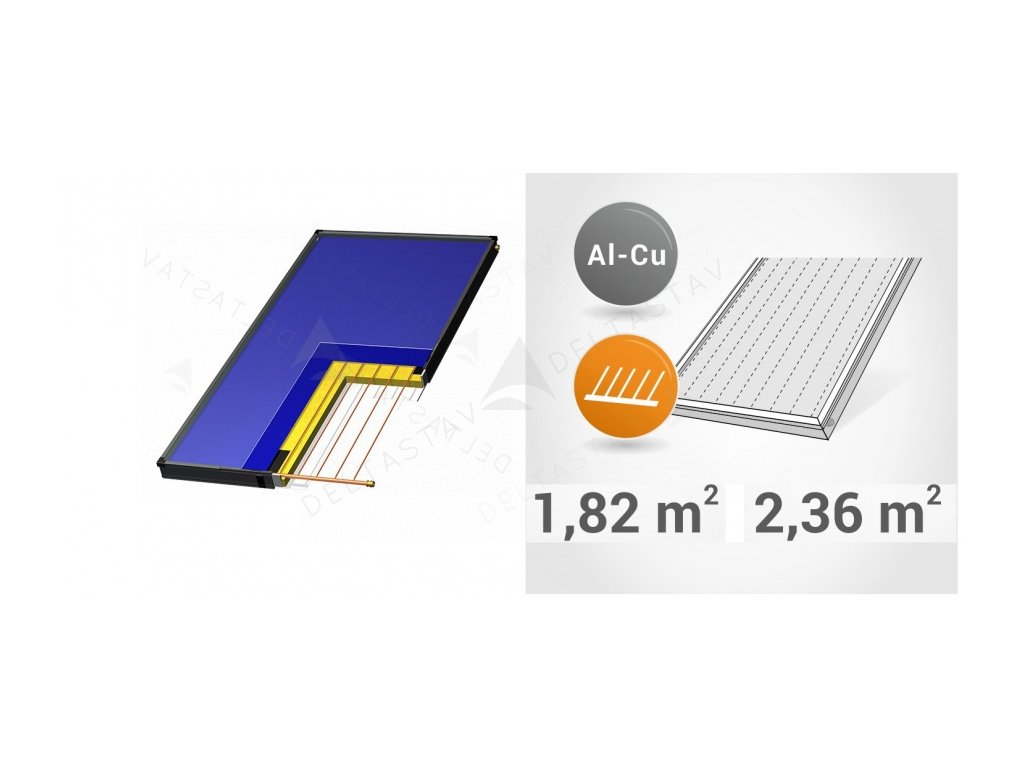
Flat plate AlCu solar collector – the aluminium and copper absorber guarantees excellent heat transfer and a long service life
Evacuated tube collector
An evacuated tube collector works on the principle of glass tubes containing a vacuum, which eliminates heat loss by convection. In theory it achieves higher efficiency at low temperatures (winter, overcast weather). In practice, however, it is more expensive, more prone to mechanical damage (hail, vandalism), and in strong summer sun the system can overheat (stagnation). For most Slovak households, where the aim is primarily DHW heating in the summer period, a flat plate collector is the more economical and lower-maintenance choice.
The solar set – what makes up a complete system
A single collector is not enough on its own. A working solar system consists of several components that must be designed and sized as a whole. That is why solar sets are so popular on the market – complete packages comprising the collector(s), cylinder, pump station, controller, expansion vessel and all the necessary accessories.
- Solar collector – captures solar energy
- Hot water cylinder with a solar coil – stores the heated water (typically 200–300 litres for a family of four)
- Circulation pump – circulates the heat transfer fluid
- Electronic controller (solar controller) – controls the pump according to the temperature difference
- Expansion vessel – compensates for pressure changes in the system
- Safety valve, thermometer, pressure gauge – safety and monitoring components
- Heat transfer fluid – a mixture of water and propylene glycol, frost-resistant down to approx. −28 °C
- Collector mounting frame – depends on the type of roof (pitched / flat / façade)
Specific products: solar sets for Slovak households
Let us look at several specific solutions that are available from ATRIA and suitable for a typical Slovak family house.
Vaillant auroSTEP VSL S 250/2 – a proven choice for both pitched and flat roofs
Vaillant is one of the most trusted names in heating technology, and its solar set Vaillant auroSTEP VSL S 250/2 T for pitched roofs is a complete solution for a household of 3–4 people. The set contains two flat plate collectors with a total absorber area of approx. 4.6 m², a 250-litre cylinder, a pump station, the auroMATIC solar controller and all the necessary connections.

Vaillant auroSTEP VSL S 250/2 T – a complete solar set for pitched roofs, 250 l cylinder
For houses with a flat roof there is the Vaillant auroSTEP VSL S 250/2 F version, whose mounting frame allows the collectors to be set at the optimum angle (usually 30–45°) even on a level surface. Both sets are designed to cover 55–70 % of the annual DHW demand of a typical household – the rest is supplied by the existing boiler, a heat pump or an electric heating element in the cylinder.

Vaillant auroSTEP VSL S 250/2 F – the flat roof version with an adjustable-angle mounting frame
Protherm HelioSet FES2 250 BM – an economical alternative
The Protherm HelioSet FES2 250 BM is another example of a complete solar set offering good value for money. Protherm (like Vaillant, part of the BDR Thermea group) offers proven solar technology with a 250-litre cylinder and two flat plate collectors. The advantages of this set are its simpler installation and the availability of a service network throughout Slovakia.
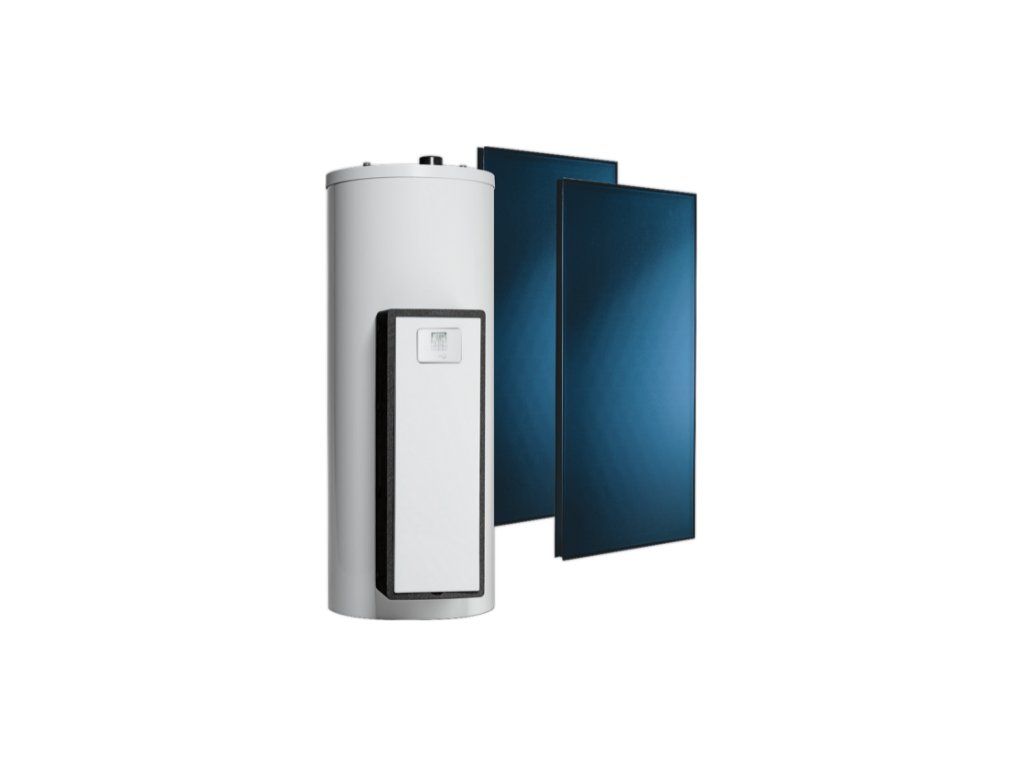
Protherm HelioSet FES2 250 BM – a solar set with an excellent price-to-performance ratio
Collector mounting frame
Fixing the collectors is a subject in its own right. For installation on a pitched roof, the collectors are either integrated directly into the plane of the roof (so-called in-roof installation) or mounted above the roof covering. For flat roofs and free-standing systems, a special mounting frame is used. ATRIA offers, for example, the mounting frame for the in-roof installation of two collectors, which allows the collectors to be integrated directly into the roof envelope – a neat-looking solution you will appreciate on new builds or roof renovations.
Slovakia and solar energy: myth or reality?
One of the most frequently repeated doubts is that Slovakia "does not get enough sun" for solar collectors to be worthwhile. This idea is misleading. Let us look at the facts.
Global solar irradiation in Slovakia ranges from 1,050 to 1,350 kWh/m²/year, with the lower values typical of the northern mountains and basins and the higher ones of the south and south-east of the country (the Danubian Lowland, the East Slovak Lowland). For comparison: Germany, where solar thermal is in widespread use, reaches values of 900–1,100 kWh/m²/year in its northern regions and only exceptionally more in the south. In other words, Slovakia's climatic conditions for solar water heating are at least as good as, or better than, those of most of Germany.
Chart: Indicative monthly yield of a solar collector (2.1 m²) in Slovak conditions – total annual yield approx. 830 kWh
The chart makes it clear that the vast majority of solar energy is produced from April to September, precisely when demand for hot water is relatively stable and no heating is needed. That is why solar thermal for DHW heating makes excellent sense in Slovak conditions – it can cover the summer months with practically no supplementary energy source.
Sizing a solar system: how many collectors and what size of cylinder?
Correct sizing is crucial. An undersized system will not cover enough of the demand, while an oversized system will regularly stagnate (overheat) in summer and needlessly wear out the heat transfer fluid and the components.
Basic rules for DHW heating
- Collector area: approx. 1.0–1.3 m² of absorber (flat plate collector) for each person in the household. For a family of four, two flat plate collectors with a total absorber area of 4.2–5.2 m² are therefore sufficient.
- Cylinder volume: 50–70 litres per person is recommended. For 4 people, a 200–280 litre cylinder is therefore suitable. 250-litre cylinders are ideal for a family of this size – it is no coincidence that they are the ones most often included in the sets on sale.
- Cylinder-to-collector ratio: as a guide, 45–55 litres of cylinder volume per 1 m² of collector.
A practical example: a family of four in the south of central Slovakia
Average hot water consumption per person at a temperature of 55 °C is approx. 40 litres/day. For 4 people that is 160 litres/day. To heat it from 10 °C (the incoming water temperature) to 55 °C we need:
Q = m × c × ΔT = 0.16 m³ × 1,000 kg/m³ × 4,187 J/(kg·K) × 45 K ≈ 30 MJ ≈ 8.3 kWh/day
A solar set with two flat plate collectors (total absorber area approx. 4.6 m²) in Banská Bystrica can, if correctly installed, produce approx. 1,800–2,000 kWh of heat a year. The year-round DHW demand for 4 people is approx. 3,000 kWh/year. The solar fraction therefore reaches 60–67 % – the rest is supplied by the auxiliary heat source (boiler, heat pump, electricity).
The financial side: prices, savings and payback in 2026
Let us turn to specific figures. Following a wave of regulation, energy prices in Slovakia in 2026 remain considerably higher than before 2021. Indicative prices for comparison:
- Electricity (peak-rate tariff): approx. 0.17–0.22 EUR/kWh (including distribution)
- Natural gas: approx. 0.07–0.10 EUR/kWh (depending on the tariff and the supply point)
Indicative annual cost of heating DHW for a household of four – with and without a solar system
How much does a solar set cost and when will the investment pay for itself?
In 2026, a complete solar set including installation for a family of four (2 flat plate collectors, 250 l cylinder, pump station, controls, mounting frame) comes to roughly 2,500–4,500 EUR, depending on the brand and the specific configuration. Premium systems from Vaillant or Protherm supplied as a complete set fall in the middle to upper part of this range.
The annual saving depends on the auxiliary heat source:
- Replacing electricity: with a solar fraction of 65 % and a price of 0.20 EUR/kWh, the annual saving is approx. 390 EUR. Payback on the net investment (without a subsidy) for a set costing 3,500 EUR: 3,500 / 390 ≈ 9 years.
- Replacing natural gas: with a price of 0.09 EUR/kWh and a boiler efficiency of 95 %, the annual saving is approx. 175 EUR. Payback: 3,500 / 175 ≈ 20 years.
These figures are before any subsidies are deducted. Under the Zelená domácnostiam (Green Households) programme, Slovakia has provided vouchers for solar thermal systems – the current status of the programme should always be checked on the website of SIEA (the Slovak Innovation and Energy Agency), as the conditions and availability change. A subsidy can cover 15–30 % of the purchase price, which shortens the payback period considerably.
Installing a solar system: what to watch out for
Orientation and tilt of the collectors
The ideal orientation is due south. A deviation of up to 30° to the south-west or south-east causes a loss of yield of only 5–10 %. The collector tilt should be 30–50° from the horizontal – for purely summer operation (DHW) 30–35° is optimal, while for year-round use including heating support in winter a tilt of 45–60° is better. On pitched roofs with a typical pitch of 30–45°, no special adjustment of the angle is therefore usually needed.
Shading
The collectors must be free of shading at least between 9:00 and 15:00 in the summer period. Even partial shading (a chimney, a neighbouring house, a tree) significantly reduces the output of the whole collector, not just of the shaded part. If shading cannot be avoided, it is worth considering an alternative location (the façade, a frame in the garden).
Connection to the existing water heating
In practice, a solar system is always combined with an auxiliary heat source – either the cylinder has a built-in electric heating element (a bivalent cylinder), or the boiler's secondary circuit is connected to the solar cylinder. A well-designed hydraulic layout ensures that the solar circuit heats the lower part of the cylinder while the boiler tops up the upper part – so the system can always supply hot water, even after several days without sunshine.
Stagnation and system protection
In the summer months a situation can arise where the cylinder is fully heated and the collectors have nowhere to send their energy – the system stagnates. During stagnation, temperatures in the collector can reach 180–200 °C. Every solar system must therefore have a correctly sized expansion vessel and a safety valve. A quality heat transfer fluid (propylene glycol) must be resistant to high temperatures and needs to be replaced every 5–8 years in line with the manufacturer's recommendation.
Legislation and permits for solar collectors in Slovakia (2026)
This subject worries many prospective buyers. In most cases the answer is good news:
Installing solar thermal collectors on a family house (on an existing roof, without changing the outline of the building) does not require a building permit or notification of building work under the Slovak Building Act (Act No. 50/1976 Zb. as amended, or the new Building Act No. 200/2022 Z. z., which has been amended repeatedly). It counts as maintenance work or as building services equipment, which is not subject to building permit proceedings provided there is no change to the structural stability, shape or appearance of the roof in relation to protected areas.
Listed buildings and protected areas are the exception: if the house is in a conservation zone or is itself a listed building, you need to request an opinion from the regional monuments board. In some cases local zoning plans also regulate the appearance of collectors – before installation it is always worth checking with the relevant building authority whether a special regime applies to the location in question.
Solar thermal vs. photovoltaics: which is better for heating water?
With the arrival of cheap photovoltaics, an alternative has appeared: building a PV system and using the surplus electricity to heat water in an electric water heater (a so-called solar boiler controlled by a surplus-power controller). What are the differences?
- Solar thermal has a conversion efficiency of 60–80 % (solar energy → heat). It is a specialised system intended directly for heating water, and cheaper when used purely for heat.
- Photovoltaics + electric water heater: a PV panel has an efficiency of 20–24 % (solar energy → electricity), and an electric water heater has an efficiency of ~99 %. The overall conversion efficiency of the sun→heat route is therefore 20–24 %. However, a PV system is far more versatile – you can use the electricity anywhere, not just for water.
From a purely energy point of view, solar thermal is more efficient for heating water. In terms of flexibility and wider use, PV with a water heater has the advantage, especially if you have or are planning a larger PV system. For households that want a simple, reliable and inexpensive solution exclusively for DHW heating without photovoltaics, solar thermal is still a very well-justified technology.
Maintaining a solar system: what and when
A solar thermal system needs relatively little maintenance. Even so, there are a few regular tasks that will ensure a long service life and correct operation:
- Checking the system pressure – once a year (ideally before the season). The pressure should be 1.5–2.5 bar when cold.
- Checking the heat transfer fluid – the pH and glycol content should be measured every 2–3 years, and the fluid replaced every 5–8 years.
- Cleaning the collector glass – in areas with heavier dust fall or where there is noticeable soiling (birds), washing with water can increase the yield by as much as 5–10 %.
- Visual inspection of the collector and pipework – once a year, especially after winter – check the seals, any corrosion and the condition of the insulation on the outdoor pipework.
- Inspection of the electrical components – pump, controller, temperature sensors – a professional service every 5 years is recommended.
A practical example: installation in an ordinary family house
In 2023 Mr Miroslav from the Nitra Region decided to install a solar set on a two-storey family house with a family of five. The house has a gable roof with a 38° pitch facing south. He installed a solar set with two flat plate collectors (total absorber area 4.6 m²) and a 250-litre cylinder. The original gas condensing boiler remained as the auxiliary heat source.
Results after two seasons:
- Annual yield of the solar system (measured by the controller): 1,720 kWh
- Solar fraction for DHW: approx. 58 % of annual demand (for 5 people this is a little less than for a family of four with the same area)
- Annual gas saving: approx. 1,810 kWh of gas (taking boiler efficiency into account)
- Financial saving: approx. 163 EUR/year at an average gas price of 0.09 EUR/kWh
- Investment (set + installation): 3,200 EUR (without a subsidy)
- Estimated payback: 19–20 years at current gas prices
Mr Miroslav's conclusion: "If I heated my hot water with electricity, the payback would be much better. With gas it takes a bit longer. But I appreciate that in summer we hardly use the boiler for hot water at all – that means convenience and less strain on the boiler too."
This example illustrates an important point: solar thermal is financially more attractive for households that heat their water with electricity. For houses on mains gas with a modern condensing boiler, the argument is energy independence and the environmental benefit rather than a short financial payback.
Frequently asked questions (FAQ)
Do solar collectors heat water in winter or in overcast weather too?
Yes, but with a much lower output. Even the diffuse (scattered) solar radiation in overcast weather contains energy that the collector can capture. In January in central Slovakia, a collector with an area of 2.1 m² can produce 8–15 kWh of heat a month – that is not much, but it is not nothing. In practice this means that in winter the solar system preheats the cold water (e.g. from 6 °C to 20–25 °C) and the boiler only has to bring it up to the final 55 °C. Even this preheating saves energy from the auxiliary heat source.
Do I have to replace my hot water cylinder if I already have one?
That depends on the existing cylinder. An ordinary simple water heater (single-walled, without a solar coil) is not compatible with a solar system. To connect to the solar circuit you need a cylinder with two coils, or at least with one solar coil in the lower part. For that reason the cylinder is usually replaced as well when a solar set is installed – sets normally include a cylinder already designed for solar use.
How large a roof is needed for the installation?
For two flat plate collectors (the most common set for a family) you need approx. 4.5–5 m² of free roof area facing south (±30°). This is not usually a problem even on an ordinary family house roof. If you do not have a suitable spot on the roof, the collectors can also be installed on the façade (vertically – lower output in summer, but better in winter) or on a frame in the garden.
What happens if I go on holiday and the cylinder is full?
The system goes into stagnation – the collector overheats, the heat transfer fluid evaporates into the expansion vessel and stays there until the system cools down. This is a normal condition, but frequent and prolonged stagnation degrades the heat transfer fluid and can put a strain on the components. If you are planning to be away for more than 2 weeks in summer, it is advisable to cover the collectors with a special shading net or to reduce their tilt. Quality systems (e.g. Vaillant) are designed to cope with stagnation, and the manufacturer accepts it as a normal operating condition that is factored into the service life of the system.
Can I also connect a solar system to support my heating?
Yes, but it requires a considerably larger collector area (5–8 m² or more) and a larger buffer tank (500–1,000 litres). In Slovak conditions, solar heating support is less efficient than DHW heating alone, because the greatest demand for heat (winter) coincides poorly with the availability of solar energy. We recommend solar heating support only for passive or low-energy houses with a low heat demand, or in combination with underfloor heating (low heating water temperatures).
Do I need installation by a certified technician?
For the system to work properly and to keep the manufacturer's warranty, yes – a solar system should be installed by a specialist with knowledge of hydraulics, solar systems and the electrical wiring of the controller. In addition, if you are applying for a subsidy from the Zelená domácnostiam programme, the installation must be carried out by a registered contractor. Under current legislation no special authorisation is required (this is not a gas appliance or pressure vessel within the meaning of the legislation for such equipment), but the technician's expertise is a guarantee of the system's reliability.
Conclusion: is solar water heating worth it in Slovakia?
The clear answer is: yes, for most family houses solar water heating is worth it – technically, in energy terms and environmentally. The financial payback depends mainly on which energy source the solar system replaces: with electric heating the payback is 8–12 years, with natural gas 15–22 years (depending on current prices and any subsidy).
The key advantages, which apply regardless of current energy prices:
- Less dependence on energy suppliers and price fluctuations
- Lower CO₂ emissions (for a family of four approx. 300–700 kg CO₂/year, depending on the source replaced)
- A longer service life for the auxiliary boiler (fewer operating hours in summer)
- A long system service life – 20–30 years with proper maintenance
- Relatively simple and undemanding operation
If you are considering an installation, the first step should be a consultation with a specialist who will assess your roof, its orientation and your existing water heating system and propose a specific design. At ATRIA you will find complete solutions from proven brands – from individual collectors to fully fledged solar sets – with expert advice available.
Do you have a question about this topic?
Can't decide, or dealing with a specific situation in your home? Write to us – we will be happy to advise.