
Manifold Accessories
Buying a stainless steel manifold is only the first step. For underfloor heating to work exactly as it should - so that every room heats to the right temperature, the system can be easily bled and serviced, and the controls respond quickly and reliably - the manifold also needs the right accessories. In practice, we find that a customer buys a good-quality stainless steel manifold, but decides to save money on the electrothermic actuators, flow meters or cabinet, or simply forgets about them. The result is often a system that can't be properly balanced, or an installation that looks rushed and causes problems during servicing. In this article we go through what accessories genuinely belong with a manifold, what they're for, how to choose them based on the number of circuits, and the mistakes people most often make when choosing them.
What a complete manifold assembly consists of
The manifold body itself (the flow and return branch with ball valves and flow meters) is only the skeleton of the system. To function as a whole, it usually needs these additions:
- Electrothermic actuators - fitted on the flow branch, they open and close a specific underfloor heating circuit together with a room thermostat.
- Ball valves with a drain valve - allow you to shut off and drain individual branches during servicing without having to drain the whole system.
- Bleed valve (automatic or manual) - lets out air that naturally builds up in the system, especially after filling or topping up water.
- Flow meters - transparent tubes with a float, right on the flow branch, used to set the flow for each circuit individually.
- Manifold insulation - a foam sleeve that reduces heat loss and prevents condensation on the pipework.
- Manifold cabinet - houses the whole assembly in the wall or on the wall surface, with a door for service access.
- Connectors, adapters and a power strip - connect the actuators to the controls, possibly to a weather-compensation or room control module.
Some of these components are included with the manifold (for example flow meters and a bleed valve are usually already built into the body on stainless steel manifolds for underfloor heating), while others - mainly electrothermic actuators, insulation and the cabinet - are bought separately, based on the number of circuits and the specific installation.
Electrothermic actuators - the heart of controlling individual circuits
An electrothermic actuator is a small drive that screws onto the flow branch valve in place of a manual wheel. Inside is a heating element and a wax or paraffin filling that expands when voltage is applied and pushes out the valve pin - this opens the circuit. Without voltage, the actuator rests in the closed position (NC type - normally closed), which is the common and recommended type for underfloor heating, since in a power outage the circuits simply close and the system shuts down safely.
On the market, and in our range, you'll find two common voltage variants:
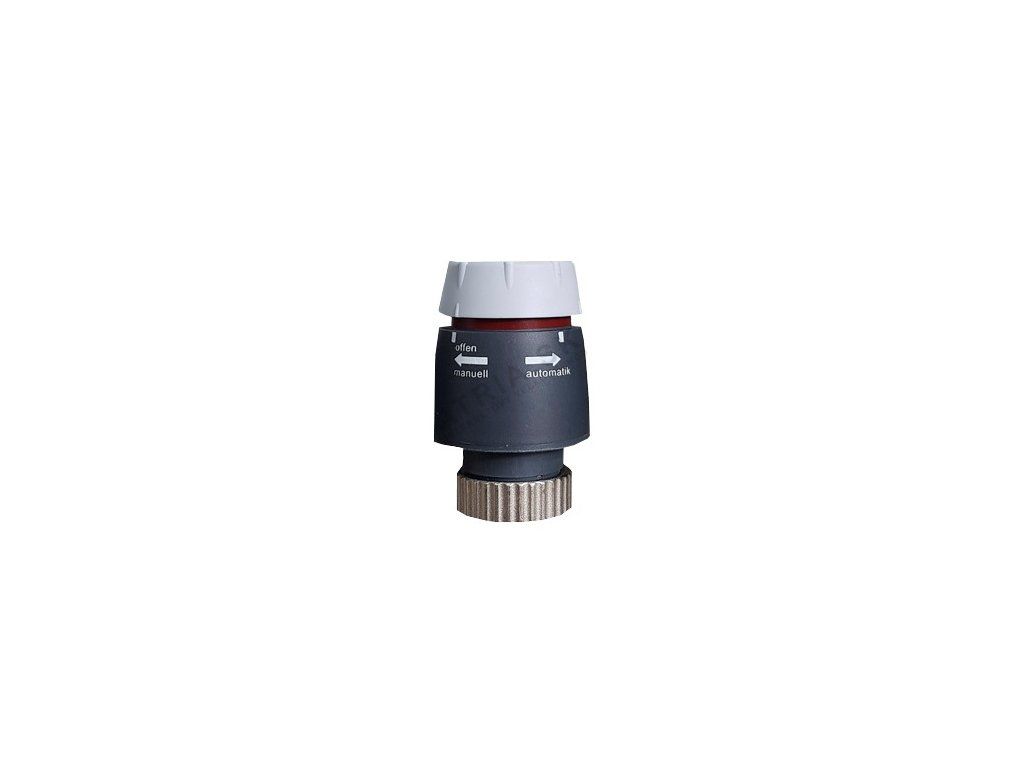 |
Electrothermic actuator 230 V - the most common choice for classic room-by-room control, connected directly to mains voltage via a junction box or the thermostat's relay, no transformer needed. Suitable where 230 V wiring is already in place in the manifold cabinet. Price from €16.36. |
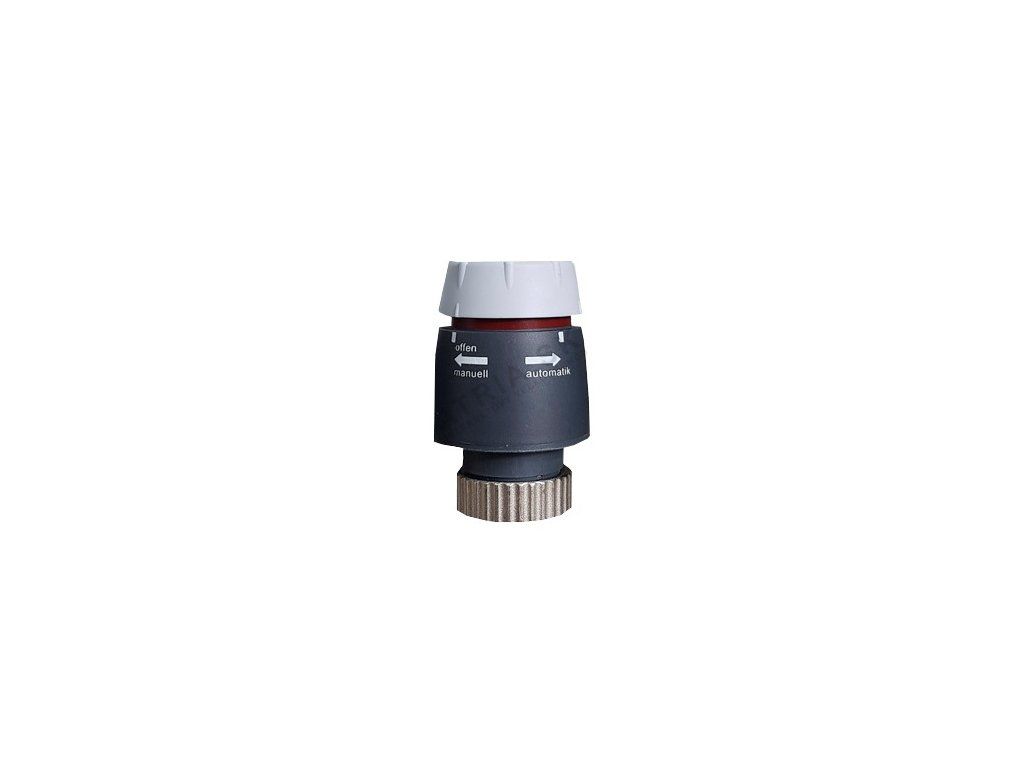 |
Electrothermic actuator 24 V - a low-voltage version that requires a separate transformer, but is safer to handle and is commonly combined with smart/room-by-room control and weather-compensation control units. Price from €16.36. |
Both variants cost the same on atria.sk - the difference is purely in the type of power supply and what control system you already have or are planning. If you're building on a classic wired thermostat without a transformer, go for the 230 V actuator. If you're planning wireless or multi-zone control with a central control module, the vast majority of such systems run on 24 V, and you should choose actuators in that version - combining both types on one manifold isn't recommended, since a control module usually has only one output of one voltage.
An important practical detail: you need exactly as many electrothermic actuators as the manifold has circuits - so 2 pieces for a 2-way manifold, 3 for a 3-way one, 4 for a 4-way one, and so on. This is the item most often forgotten when ordering, since the manifold is bought as one product in the shop, and the actuators as a separate item in a different category.
Wiring diagram of a single circuit with an electrothermic actuator
Ball valves, drain valves and bleeding
Good-quality stainless steel manifolds for underfloor heating in our range have ball valves at both ends (flow and return) already integrated into the manifold body, along with a bleed valve and a drain cock. Why these elements also matter individually, since you sometimes buy replacement parts or extra fittings for them:
- Ball valves at the inlet and outlet let you disconnect the whole manifold from the rest of the system - for example when replacing a pump group or servicing the boiler - without having to drain the water from the underfloor heating.
- The drain valve (usually with a 1/2" hose connector) is used to partially or fully drain a given branch, for example to flush a circuit clogged with debris.
- Bleed valve - an automatic type (a so-called "pot") lets air out continuously without operator intervention, a manual type requires occasional opening with a key. On underfloor heating manifolds, a combination of automatic bleeding at the highest point of the manifold plus the option of manual venting during the initial fill, when there's the most air in the pipework, has proven itself in practice.
If any of these elements is missing (for example on an older installation where only part of the assembly is being replaced), it can be bought separately as a replacement part, but for a new installation we clearly recommend a manifold that has all three functions (shut-off, drainage, bleeding) already built in from the factory - saving you installation time and reducing the number of joints that could start leaking over time.
Flow meters and setting individual circuits
A flow meter is a transparent tube with a float, part of the flow branch at each circuit individually. It lets you visually read and, with a regulating ring, set the water flow in litres per minute for that circuit. This is key to balancing underfloor heating, since each room has a different heat loss, a different circuit length, and therefore needs a different flow so the heating pipe warms evenly across its whole area.
In practice, setting the flow meters is done only after the system has first been filled and bled, usually at commissioning or during seasonal heating adjustment. The rough procedure used by installation companies: first the required flow for each room is calculated or estimated (based on heat loss and circuit length), then all the flow meters are set to this value, and after a few days of operation they're fine-tuned based on how warm each room actually feels.
Manifold cabinet and insulation
A manifold cabinet isn't just a cosmetic extra. It protects the whole assembly from mechanical damage, allows locking (important especially in commercial premises or apartment buildings), and provides space to house any control electronics or the power strip for the electrothermic actuators. The number of manifold circuits is the deciding factor for cabinet size - the more circuits, the wider (or deeper, for a flush-mounted version) cabinet you need, so that the actuators with their connectors fit without the door having to be forced shut.
Manifold insulation (usually a two-part foam sleeve that simply clips around the body) has two effects: it reduces heat loss radiating from the manifold's surface into the surrounding space (for a cabinet recessed into the wall, this is heat that would otherwise leak into the structure), and it also prevents moisture condensation on the cooler parts of the pipework, especially the return branch during transitional periods, when the difference between water temperature and the surrounding air is greater.
How to choose accessories by number of circuits - a practical overview
The simplest way to work out everything you need for a manifold is to start from the number of circuits (ways). Below is a comparison of the three most common stainless steel manifold sizes in our range, along with the approximate price of the manifold body itself (without actuators, cabinet and insulation):
On top of that you then add the price of the electrothermic actuators - at €16.36 per piece, a complete set of actuators for a 2-way manifold comes to about €32.72, for a 3-way one about €49.08, and for a 4-way one about €65.44. This amount is often forgotten when planning a budget in practice, since it's bought as a separate item, apart from the manifold itself.
Overview of required accessories by manifold size
Typical accessory installation procedure
The order of steps for fitting a manifold and its accessories has become established in practice as follows:
Step by step
Electrothermic actuators are fitted only after the pressure test - the reason is practical: during the test, the manifold's valves are left manually fully open (without an actuator), so the tightness of all joints can be checked even at the higher test pressure, which an actuator would never reach in normal operation. Only after a successful test and filling the system are the actuators fitted, wired into the controls, and the flow on individual branches set.
Recommended products on this topic
If you're putting together a complete manifold assembly for underfloor heating, here are the products most often combined:
 |
2-way stainless steel manifold for underfloor heating - suitable for smaller flats or heating one or two rooms; it needs 2 electrothermic actuators. Price from €53.68. |
 |
3-way stainless steel manifold for underfloor heating - the most versatile size for a typical house with 2-3 rooms on underfloor heating, needs 3 electrothermic actuators. Price from €69.39. |
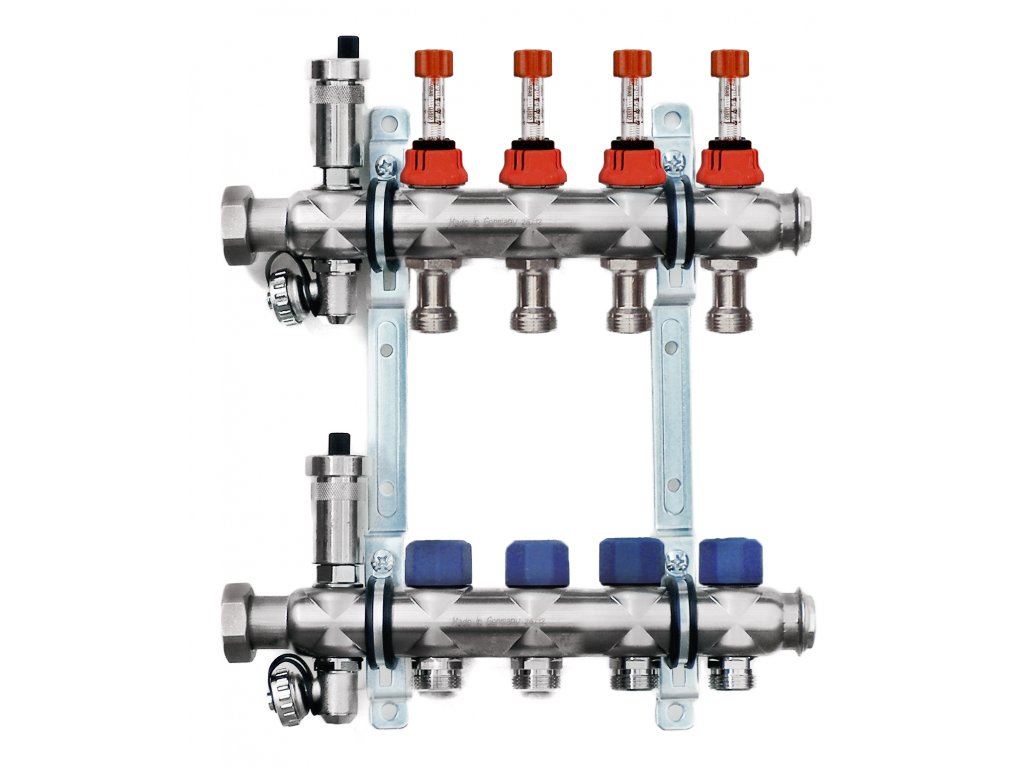 |
4-way stainless steel manifold for underfloor heating - for larger layouts or a larger number of independently controlled zones, requires 4 electrothermic actuators and usually a wider cabinet. Price from €85.32. |
|
Electrothermic actuator 230 V - an essential addition for every manifold circuit if you want to control each room independently via a room thermostat. Price from €16.36. |
The most common mistakes when choosing accessories
Over years of sales and advice, the same mistakes keep recurring - and they're all easily avoided once you know about them:
- Buying a manifold without actuators - a customer orders the manifold body but forgets that actuators are bought separately. The system can technically be connected without them (manual control via the wheel), but the main advantage of underfloor heating - automatic room-by-room control - is lost.
- Combining 230 V and 24 V actuators on a single manifold without matching wiring - this results in some circuits not responding to the controls at all, since the control module only has one type of output.
- Underestimating cabinet size - after fitting the actuators and connecting the connectors, the cabinet door won't close, or the actuators press against the cabinet wall and get damaged over time.
- Skipping insulation - a manifold built into the wall without insulation needlessly heats the structure instead of the room, and moisture can condense on the pipework at the cooler points (especially the return).
- Not setting the flow meters after installation - the manifold is left at the factory default values, even though each room needs a different flow. The result is cold, or conversely overheated, rooms despite functioning controls.
When dealing with situations like these, it's also worth reaching for additional equipment such as a room thermostat or a control unit - the Avansa 2003 product is an example of a commonly used component in this kind of underfloor heating control assembly (price from €20.05), though its specific wiring should always be checked against the type of your particular control system.
 |
Avansa 2003 - an additional component for an underfloor heating control assembly, worth discussing together with your choice of electrothermic actuators based on your type of thermostat. Price from €20.05. |
Servicing and lifespan of accessories
Under normal operation, electrothermic actuators typically last several years to a few decades, but their most common fault isn't the drive itself, it's the valve getting clogged with debris from the pipework (especially on older systems without a filter, or after a long shutdown). This shows up as the actuator physically moving (an audible click, warm to the touch), but the circuit doesn't open - in that case, briefly unscrewing the actuator and manually flushing the valve helps. Ball valves and drain valves need essentially no maintenance, but it's recommended to visually inspect the whole assembly once a year, ideally before the heating season - checking for any micro-leaks at joints, that the bleed valve works, and the condition of the insulation.
We recommend rechecking the flow meters whenever there's a change in the system - for example after replacing a floor covering (carpet/tiles change the structure's thermal resistance), after insulating the house, or after a change in room occupancy. A setting that worked years ago may not be optimal after such changes.
Frequently asked questions
Do I need an electrothermic actuator on every manifold circuit?
Yes, if you want to control each circuit independently via a room thermostat. Without an actuator, a circuit can only be controlled manually via the wheel directly on the manifold, which in practice means either a permanently open or permanently closed state - with no automatic response to room temperature.
What's the difference between a 230 V and a 24 V electrothermic actuator?
The difference is in the supply voltage and the related wiring. A 230 V actuator connects directly to mains voltage (via the thermostat's relay), a 24 V actuator needs a separate transformer, but is safer to handle and is commonly used in smarter or multi-zone control systems. Both cost the same on atria.sk, €16.36 - the choice depends on your control type, not the price.
Can I combine 230 V and 24 V actuators on one manifold?
This isn't recommended. A control module or thermostat usually has one type of output at one voltage, so combining them would mean some circuits don't respond to the controls at all. If you're not sure which type you need, check against your existing or planned control system before ordering the actuators.
How do I know what size cabinet I need for a manifold?
The deciding factor is the number of manifold circuits (ways), and whether you plan to house the actuator power module or a control unit in the cabinet too. A smaller/narrower cabinet is enough for a 2-way manifold; for a 3-way, and especially a 4-way one, we recommend a wider or deeper version, so there's enough room to comfortably close the door after fitting the actuators and connecting the connectors.
Why are actuators fitted only after the system's pressure test?
During the pressure test, the manifold's valves are left manually open without an actuator, so the tightness of the joints can be checked even at a higher test pressure than an actuator would ever see in normal operation. Actuators are fitted and wired only after a successful test and filling the system.
Is manifold insulation needed if it's built into the wall?
Yes. Without insulation, the manifold needlessly transfers heat into the surrounding structure instead of the heated space, and moisture can condense at the cooler points of the pipework (especially the return), which isn't good for the surrounding masonry or the cabinet itself over the long term.
Related topics
- How to choose a stainless steel manifold
- How many manifold circuits do I need
- Installation and connection of a manifold
- Bleeding and setting up a manifold
- Manifold cabinets - what size
- Maintenance of a stainless steel manifold
You'll find the complete range in the main category Stainless steel manifolds.
Do you have a question on this topic?
Can't decide, or dealing with a specific situation in your home? Write to us - we're happy to help.